 By Danielle Evaland
How does ChatGPT decide which businesses to name?
Let's clear up the biggest misunderstanding first, because it changes everything you do next. ChatGPT doesn't have a little directory of businesses that it charges to appear in. When someone asks it "who's the best electrician near me?", it doesn't pull up an ad slot. It reads the web, weighs up what it can find about the businesses in that area, and writes a short answer naming the ones it understands best and trusts most.
So the honest answer to "how do I show up?" is this: you make yourself the easiest business for ChatGPT to read, believe and recommend. There's no shortcut around that, and I'll be straight with you – anyone selling you a "guaranteed spot in ChatGPT" is selling you something that doesn't exist.
Getting picked by AI tools is called Generative Engine Optimization, or GEO. It's the AI-era cousin of SEO – except instead of ranking in a list, you're trying to be named inside one written answer.
Here's the part that surprises most owners. ChatGPT and old-fashioned Google rankings are drifting apart. One analysis found the overlap between the sources AI tools cite and the top pages Google ranks is now only a small fraction of what it used to be. In other words, being on page one of Google no longer guarantees you a mention in the AI answer. They're two different games now, and you have to play both.
ChatGPT recommends businesses it can read clearly, understand correctly and trust. Everything below is just a practical way to become that business.
Seven steps to show up in ChatGPT

Right, let's get practical. These are the moves I'd walk any business owner through, roughly in the order I'd do them. You don't need to be technical to understand them, and you don't need to do all seven this week. Start at the top and work down.
My honest advice: don't try to do all seven at once and burn out. Steps one and two – readable site, consistent facts – give you the biggest jump for the least effort. Nail those, then keep going.
Which steps move the needle fastest?
Not every step pays off at the same speed. Some fixes can change what ChatGPT says about you within weeks. Others build slowly, like compound interest. Here's how I'd think about the trade-off, so you spend your energy where it counts.
| What you do | Effort | How fast it shows |
|---|---|---|
| Fix conflicting business facts | Low | Fast – weeks |
| Make the site readable to AI | Medium | Fast to medium |
| Add schema / structured data | Medium | Medium |
| Answer-first content | Ongoing | Medium – builds up |
| Reviews and mentions | Ongoing | Slow but sticky |
There's good evidence behind putting content near the top of that list, too. In a peer-reviewed study of thousands of real queries, researchers found that simply adding clear statistics, citing sources and quoting experts could lift a page's visibility in AI answers by up to around 40 percent – and it even helped lesser-known sites punch above their weight. Structured content – headings, bullets, lists, tables – gets cited noticeably more often than plain walls of text.
The takeaway I'd give you: the "boring" fixes at the top of the table are where most businesses win. Get read, get your facts straight, then layer the slower trust-building on top.
Why do reviews and mentions matter so much?

This is the step owners most often underrate, so I want to spend a minute on it. When ChatGPT decides whether to trust you, it doesn't just read your website – it reads what the rest of the internet says about you. And it turns out that carries enormous weight.
Read those numbers again. The bulk of what AI trusts comes from places you don't control – reviews, mentions, being talked about. That's a little uncomfortable, because you can't just write it yourself. But it's also good news: it means a genuinely good business, with real happy customers, has a natural advantage. Your job is to make that reputation visible and easy to find.
You can polish your own website all day. But the businesses AI trusts are the ones other people vouch for.
Danielle Evaland, Founder of EvaraSo, practically: ask every happy customer for a review. Keep your Google Business Profile active. Get listed and mentioned in your local and industry directories. If you've done real work worth talking about, help people talk about it. This is slow, it doesn't feel like "marketing," and it's one of the highest-leverage things you can do.
What does "answer-first content" actually mean?
I keep saying "answer-first," so let me show you exactly what I mean, because it's simpler than it sounds and it's the writing habit that pays off most.
Most business web pages bury the answer. They open with a paragraph about "welcoming you to our family-run team since 1998" and only get to the useful bit halfway down. An AI reading that page has to hunt for the answer, and often just moves on to a competitor who made it easy. Answer-first means you flip that around: lead with the answer, then explain.
- Ask a real question as your heading. The exact thing a customer would type or say. Not "Our Services" – "How much does a boiler service cost?"
- Answer it in the first sentence or two. Clear and self-contained, so it makes sense even lifted out on its own. AI tends to pull most from the opening of a section.
- Then add the detail. The context, the numbers, the "it depends" caveats – all fine, once the plain answer is already there.
- Add a short FAQ. FAQs are among the most-cited formats in AI answers, because every question is a ready-made, quotable little answer.
The page you're reading is built exactly this way, on purpose. Notice the "In short" box at the top? That's the answer, first, before any of the detail. That's not a coincidence – it's practising what we preach. Do that across the pages that matter, and you make yourself very easy for an AI to quote.
One thing not to do: don't stuff your pages with keywords or repeat your town name fifty times. The old SEO tricks don't just fail with AI – research shows they can actually hurt you. Write for a human first, structure it for a machine second.
How long before ChatGPT starts naming you?
Here's the honest timeline, because I'd rather you had realistic expectations than a nasty surprise. Some changes land fast. If ChatGPT is getting a fact about you wrong and you fix that fact everywhere, the answer can improve in a few weeks. But building real trust – the reviews, the mentions, the track record – takes months. This is a garden, not a light switch.
The good news is that ChatGPT rewards businesses that keep their house in order. Fresh, recently updated information gets cited far more than pages that haven't been touched in years. So the businesses that win aren't necessarily the biggest – they're the ones that stay consistent and keep their details current while their competitors let theirs go stale.
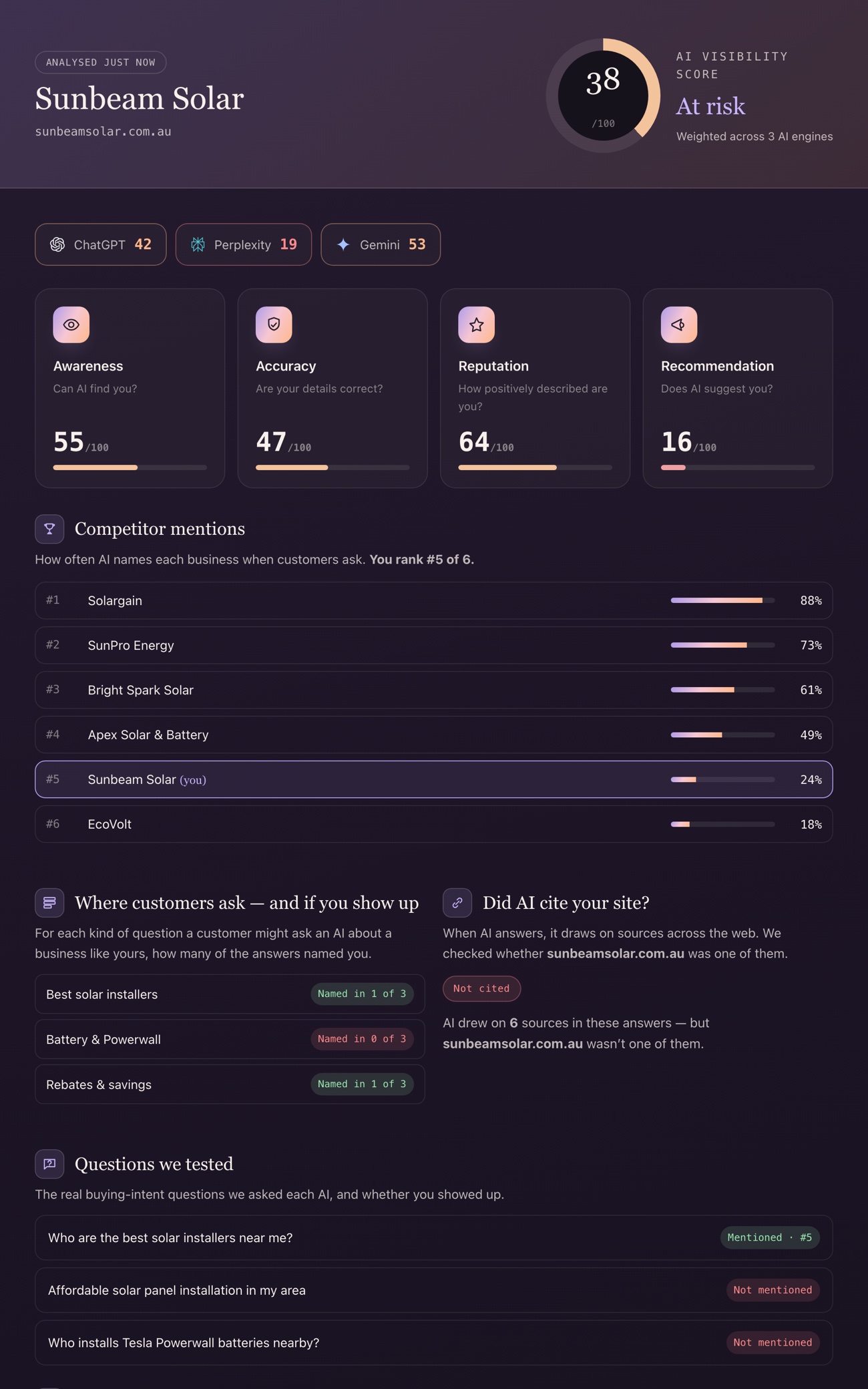
If you'd rather see where you stand before doing any of it, our free AI Visibility Audit asks the engines about you and hands you a score and a fix list, no strings.