 By Danielle Evaland
Why solar is a perfect storm for AI
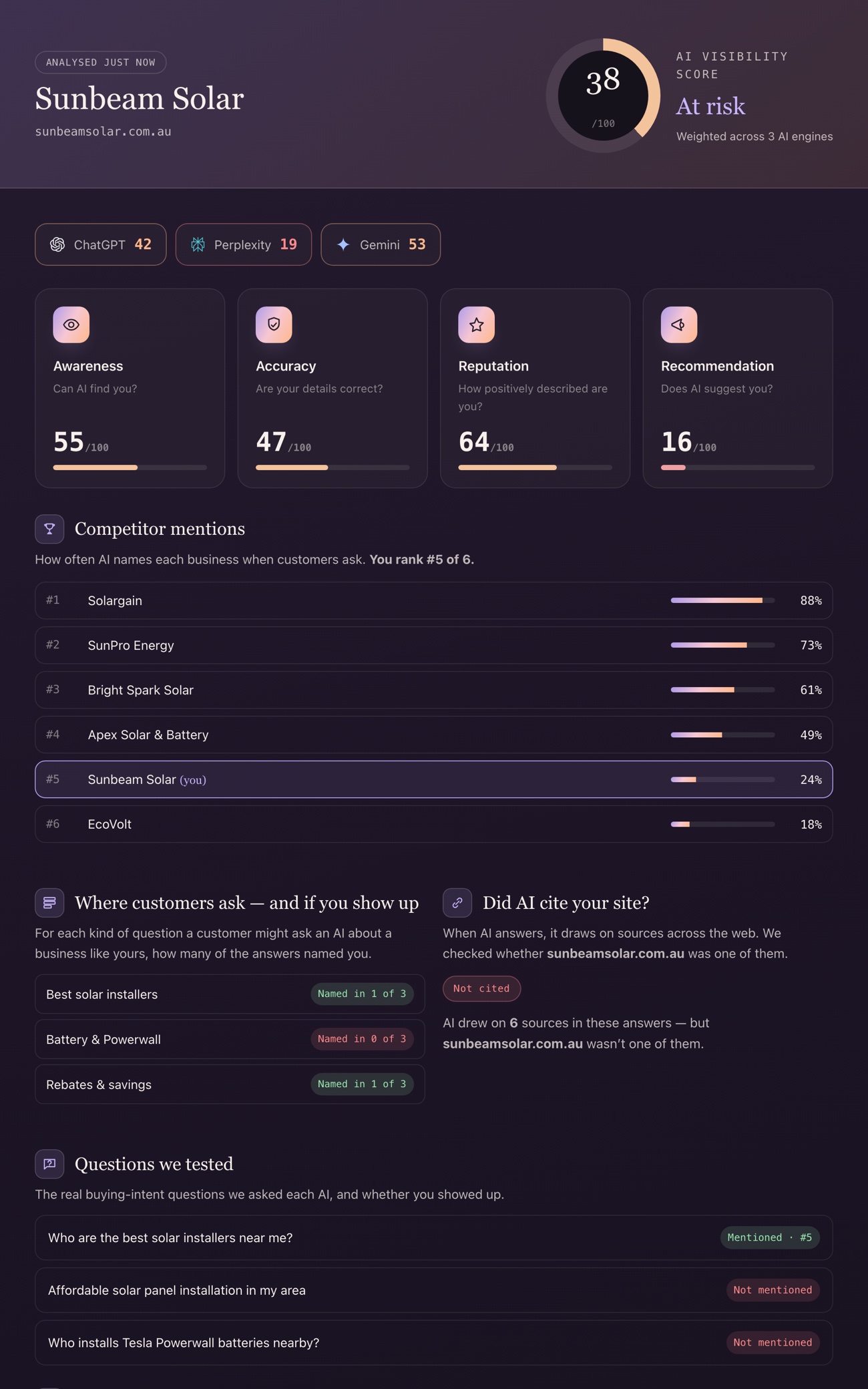
Solar is one of the industries where getting this right matters most, and here's why. A solar system is a big, expensive, once-in-a-decade decision, so homeowners research it hard before they call anyone. That research increasingly starts with a question typed into AI: "Who's the best solar company near me?" or "Is [installer] any good?" The answer they get shapes who they even consider.
Now put that next to how few businesses AI actually names.
Look at the last two numbers together. In SOCi's 2026 study of nearly 350,000 businesses, they showed in Google's local pack about 36% of the time but were recommended by ChatGPT only 1.2% of the time. For solar, that gap is brutal, because you're probably already spending heavily on Google Ads and SEO – and none of that guarantees you appear when a homeowner asks AI. Combine a high-ticket sale, heavy research, and AI naming barely one business in a hundred, and being invisible costs you real, expensive jobs.
How AI picks which solar company to name
AI doesn't inspect your installs or check your workmanship. It reads what the web says about solar companies in an area and repeats the option it can describe most confidently. For solar specifically, a few signals do most of the deciding.
- Reviews, and lots of them. Solar is high-trust and high-cost, so AI leans hard on reputation. Reviews on Google and on solar comparison sites weigh heavily in who it names.
- Clear credentials. Accreditations and licences tell AI you're legitimate. A company that states them plainly is easier to recommend than one that leaves AI guessing.
- Consistent local presence. Your name, service area and contact details matching across Google, your site and directories tells AI exactly where you operate and that you're real.
- A website it can read. If the systems you install and the areas you cover are only in images and a savings calculator, AI can't see them. Plain text wins.
In solar, reputation and credentials are the currency. AI recommends the installer it can verify is trusted, qualified and local, not necessarily the one who does the best work.
Why reviews and credentials decide it
In most trades, reviews help. In solar, they're close to everything. A homeowner handing over five figures wants proof they won't be burned, so AI mirrors that caution and weights trust signals heavily. Two things matter most.
First, reviews on the platforms buyers and AI both trust. Beyond Google, solar has its own respected comparison sites – SolarReviews and EnergySage in the US, SolarQuotes in Australia – and AI leans on them because that's where real, verified solar reviews live. Being present and well-reviewed there is one of the strongest signals you can build.
Second, credentials, stated plainly. Your accreditation (NABCEP in the US, Clean Energy Council accreditation in Australia), your electrical licences, the panel and battery brands you're certified to install, and your warranties. These aren't just trust-builders for humans; they're the facts AI uses to decide you're a legitimate, qualified choice rather than a risk.
Solar-specific edge: because Gemini reads Google Maps directly, a fully completed Google Business Profile with a steady stream of recent reviews can put you into one of the three big AI engines almost on its own. It's the highest-value hour a solar installer can spend.
What most solar websites get wrong

Solar websites tend to be some of the best-looking sites in any trade: big hero images of panels at sunset, sleek animations, an interactive savings calculator. And that's exactly the trap. All that visual polish often means the important facts – which systems you install, where you work, your accreditations – live inside images, scripts and the calculator, where AI can't read them. Your site looks premium to a homeowner and nearly blank to an AI.
The fix isn't to make your site uglier. It's to make sure the facts that matter also exist in plain, readable text: your service area written out, the panel and battery brands you install, your accreditation and licence numbers, your warranties, and clear answers to the questions homeowners actually ask. Keep the beautiful design; just don't let it be the only place your information lives. We cover the how in how to make your website readable to AI.
The best-looking solar sites are often the most invisible to AI. Gorgeous to a homeowner, blank to the machine deciding who gets recommended.
Danielle Evaland, Founder of EvaraThe steps to get into AI answers
Here's the order I'd work in if you install solar and want to start being named. None of it is complicated; it's about giving AI clear, consistent, trusted information to work with.
Where to start
Start by finding out where you actually stand, because it's free and it tells you how big the gap is. Ask ChatGPT, Perplexity and Gemini for the best solar company in your town and see whether you're named, whether your details are right, and which competitors keep coming up instead. Try it a few different ways, too, since homeowners phrase it differently and each engine draws on different sources. That five-minute check turns a vague worry into a clear, ranked list of what to fix first.
If you'd rather see it scored properly across every engine – with the competitors who are beating you and the specific fixes ranked by impact – that's exactly what our free AI Visibility Audit does in about 60 seconds. Either way, the businesses winning solar leads from AI right now are mostly the ones who simply started earlier. In an industry this competitive, that head start is worth having.
One more thing for solar: AI visibility pairs perfectly with speed. Homeowners comparing installers contact several at once, so being named by AI and replying within minutes is how you win the job. If you want to see what AI says first, check what AI says about your business.