 By Danielle Evaland
What AI visibility actually means

Think about the last time you needed a plumber, an accountant or a good coffee in a new town. A few years ago you'd have typed it into Google and picked from a list. Today, a fast-growing number of people just ask an AI: "Who's the best emergency plumber near me?" And the AI gives them one clear answer, often with two or three names and a reason to trust each one.
AI visibility is whether your business is one of those names. It's the difference between the AI knowing you exist, understanding exactly what you do, believing you're any good, and saying so out loud – versus the AI never mentioning you at all.
AI visibility = how findable, understandable and recommendable your business is to AI tools like ChatGPT, Gemini, Perplexity and Google's AI Overviews.
It has three parts, and you need all three. The AI has to be able to find you (read your website and the mentions of you around the web). It has to understand you (know what you sell, where, and to whom, without getting it wrong). And it has to trust you enough to recommend you over the business next door. Miss any one of those and you drop out of the answer.
Why search changed under our feet
This didn't creep in slowly. It happened fast, and most business owners haven't caught up yet. Here's the scale of it.
Two billion people a month now meet an AI-written answer before they ever reach the old list of links. When the answer sits at the top and names three businesses, most people never scroll past it. The "ten blue links" still exist, but for a huge slice of searches they're no longer where the decision gets made.
That's the shift in one sentence: search used to hand people a list to choose from. Now it increasingly hands them a choice already made. Your job used to be ranking in the list. Now it's being the choice.
Being on Google isn't the same thing anymore
This is the part that trips people up. "But I'm on the first page of Google," they say. That's great – and it's no longer enough on its own. Ranking well and being named in the AI answer are now two different games, played by different rules.
| Traditional SEO | AI visibility | |
|---|---|---|
| What you're competing for | A spot in a list of links | A named mention inside one answer |
| What the customer sees | Ten options to compare | Two or three, already recommended |
| What matters most | Keywords, links, page speed | Clear facts, consistency, trust signals AI can read |
| Where you can lose | Page two | Not mentioned at all |
An AI doesn't "rank" you the way Google's old list did. It reads the web, decides what it believes is true about you, and writes a recommendation in its own words. So you can be number one on Google, have a beautiful website, and still be missing from the AI's answer – because the AI couldn't read your site cleanly, found conflicting facts about you, or simply trusted a competitor more.
The simplest way to think about it: SEO gets you into the room. AI visibility gets you introduced by name.
What AI looks at when it picks a business
AI tools don't have opinions or gut feelings. They pattern-match on what they can read. When they decide who to recommend, a few things carry most of the weight:
- Can it read your site at all? If your key facts are locked inside images, sliders or heavy scripts, the AI may see a nearly blank page.
- Do your facts agree everywhere? Your name, address, phone, hours and services should match across your site, Google, Facebook and directories. Conflicting facts make AI unsure, and unsure means skipped.
- Do others vouch for you? Reviews, mentions and being listed in trusted places tell the AI you're real and reliable.
- Do you answer the actual question? Content written as plain answers to real questions is easy for AI to quote. A page of marketing fluff isn't.
Notice what's not on that list: clever slogans, a big ad budget, or being the oldest business in town. None of that helps if the AI can't read you or can't tell what you do. We go deeper on the fixes in how to make your website readable to AI.
AI recommends businesses it can read clearly, understand correctly, and trust. Fix those three things and you become an easy "yes" for the AI to give.
What being invisible actually costs you

Here's the uncomfortable bit, and the reason I care about this so much. When you lose a customer to bad AI visibility, you don't get a bounced email or a missed call. You get nothing. The customer asked the AI, got three names that weren't yours, called one of them, and you never knew they existed. There's no lead to follow up, no "we went with someone else" – just silence.
The scariest kind of lost sale is the one you never find out about. AI-driven searches are exactly that kind.
Danielle Evaland, Founder of EvaraAnd it compounds. Every month you're not in the answer, a competitor is – and the AI learns to trust the business it keeps recommending. The gap doesn't stay the same size. It widens, quietly, while your website looks perfectly fine to you.
My honest view: this is the biggest, least-noticed shift in how customers find businesses since Google itself. The businesses that sort it out early won't just keep up – they'll pick up the customers their slower competitors are losing without realising.
How to find out where you stand
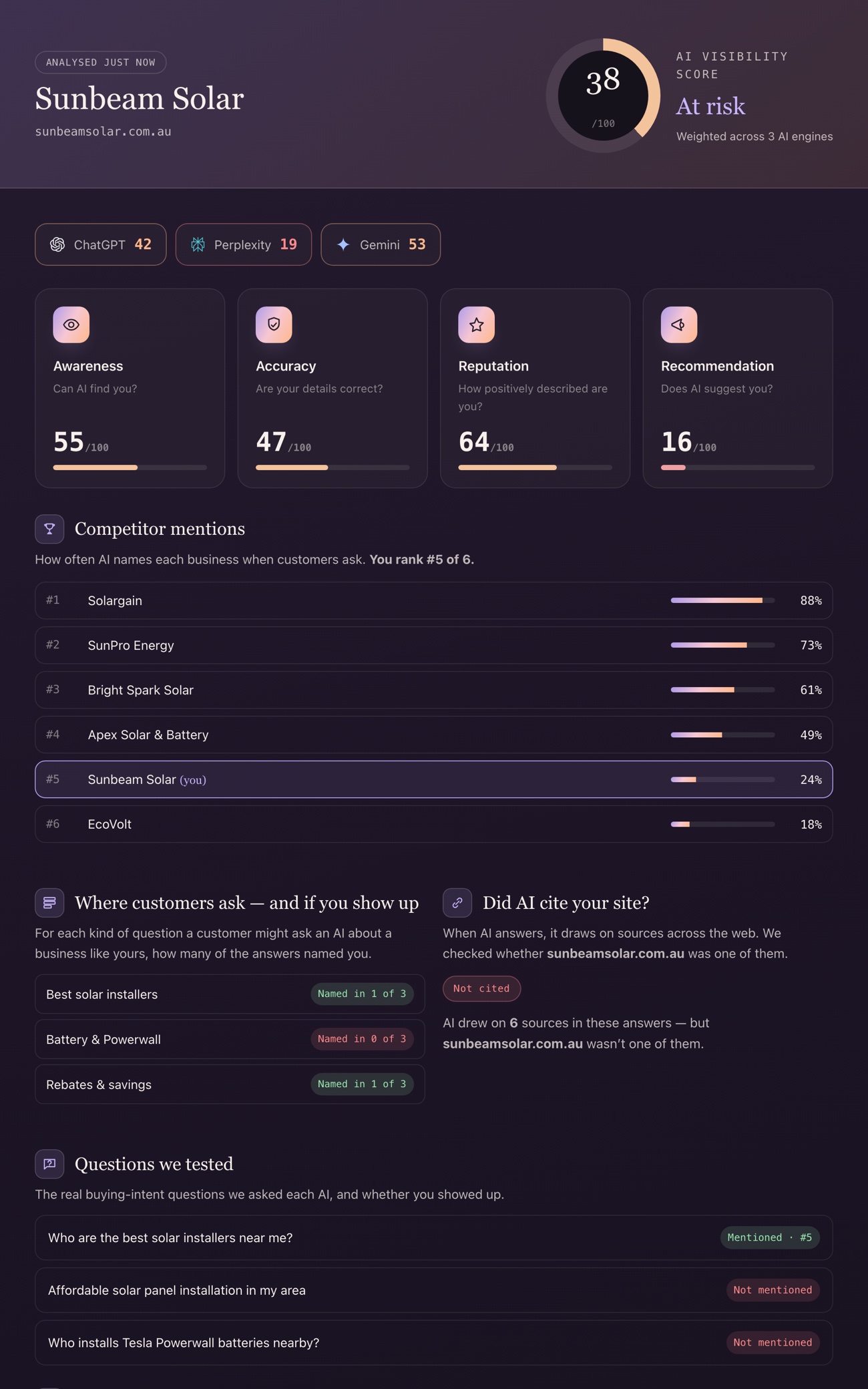
You don't have to guess. The fastest way to see your AI visibility is to do what your customers do: ask the AI.
If you're not named, or the AI gets your details wrong, that's your AI visibility problem in black and white – and it's fixable. If you'd rather have it done properly across every major engine, with a clear score and a fix list, that's exactly what our free AI Visibility Audit is for.
One warning: AI answers change and can be wrong or out of date. Checking once tells you today's picture. Staying visible means keeping your facts clean and watching what the AI says over time.