 By Danielle Evaland
The five reasons it happens
It's a horrible feeling. You ask ChatGPT about your own business and it gives out the wrong phone number, says you're closed when you're open, or describes a service you stopped offering years ago. Worse, a customer might be seeing that same wrong answer right now – and quietly calling someone else because of it.
Here's the reassuring part: this almost never happens for one mysterious reason. In our work at Evara it comes down to the same short list, over and over. Once you can see which one is biting you, it's fixable.
- Conflicting facts across the web. Your site, Google, Facebook and directories each say something slightly different, so the AI can't tell which is true.
- Outdated or duplicate listings. An old address, a number you dropped, or two profiles for the same business pull the AI toward stale information.
- A site the AI can't read well. If your key facts are trapped in images or heavy scripts, the AI reaches for whatever it can find elsewhere.
- Plain AI "hallucination". When the AI isn't sure, it's built to guess confidently rather than say "I don't know".
- Stale training data. Part of what an AI "knows" is frozen from months or years ago, so recent changes to your business may not have landed yet.
We'll walk through the big ones, then get into the fixes. The first is the one people find hardest to believe, so let's start there.
When the AI simply makes it up
People assume AI is a fancy search engine that looks up a fact and repeats it. It isn't. A tool like ChatGPT works by predicting the next few words that sound right, based on patterns it learned from huge piles of text. Most of the time that produces something accurate. Sometimes it produces something that reads beautifully and is completely wrong.
An AI "hallucination" is when the model states something false with total confidence – not lying, just filling a gap with a plausible-sounding guess instead of admitting it doesn't know.
Why would a clever system guess instead of saying "I'm not sure"? Researchers behind the 2025 paper Why Language Models Hallucinate put it plainly: the way these models are trained and tested rewards confident answers over honest uncertainty. During training and benchmarking, a wrong-but-confident answer often scores better than "I don't know", so the model learns to always have a go – a bit like a student guessing on an exam because a blank gets zero marks anyway.
For your business, that means an AI faced with a thin or messy trail of information about you won't leave a blank. It'll invent a plausible phone number, assume your hours, or guess your service area. And it'll say it as if it's certain. This is also why stale training data bites: if the version of the AI a customer is using learned about the world a year ago, your new address or rebrand may simply not exist in its memory yet.
The useful takeaway: you can't stop AI from being willing to guess. But you can make the truth so clear and consistent that guessing is unnecessary. That's the whole game.
When your own facts don't agree

This is the biggest cause we see, and the most fixable. Over the years, your business quietly spreads copies of itself across the web – your website, your Google Business Profile, Facebook, Instagram, and a dozen directories you may have forgotten you're even listed on. Every one of those holds a version of your name, address and phone number (the industry calls this your "NAP").
The trouble is, they drift. You changed your number but only updated it in two places. You moved suite, but an old listing still shows the old street. A directory from 2019 still lists a service you dropped. Now imagine an AI trying to answer "what's their number?" while looking at this:
| Where AI looks | What it finds |
|---|---|
| Your website | Open till 6pm · 0400 111 222 |
| Google profile | Open till 5pm · 0400 111 999 |
| An old directory | Listed as "moved / closed", a third number |
| No hours shown · yet another number |
To the AI, that's not one business with a small admin mess. It's four sources that disagree, and no obvious way to know which is right. So it does what it always does when unsure: it picks one, blends them, or guesses. This isn't just an AI problem, either – it's exactly what confuses traditional search engines too. Inconsistent details make Google unsure it can trust your information, and unsure businesses get pushed down.
And customers feel it just as hard as the machines do. The numbers on this are stark.
Read that last one again. Your customer isn't looking at one clean profile – they're cross-checking around six different places, and so is the AI. If those places disagree, both the human and the machine lose confidence in you at the same time. Consistency isn't housekeeping. It's the single biggest lever you have over what AI says about you.
When AI can't read your site
Here's a subtle one. Your website might have all the right facts – correct hours, current number, clear services – and the AI still gets you wrong, because it couldn't actually read them.
AI reads the plain text and structure of a page. If your opening hours live inside an image, your services sit in a slideshow that only loads when a human scrolls, or your key details are buried in heavy scripts, the AI may see a near-blank page where you see a beautiful site. When your own site goes quiet like that, the AI falls back on those other, messier sources – the old directories and mismatched profiles – and repeats whatever they say.
Think of it like this: your website should be the loudest, clearest, most trustworthy voice describing your business. If it's mumbling, something else gets to speak for you, and you don't get to choose what.
If your website can't tell the AI who you are in plain words, don't be surprised when a stranger's outdated listing does it for you.
Danielle Evaland, Founder of EvaraWe go much deeper on this in how to make your website readable to AI. For now, just know that "readable" and "good-looking" are two different things, and AI only cares about the first one.
How to fix it, step by step

Now the good bit. Fixing what AI says about you isn't magic, and you don't need to understand a line of code. It's mostly about doing one boring thing brilliantly: making the truth about your business clear, consistent and easy to read everywhere it appears. Here's the order we work in.
None of these steps is hard on its own. The work is in being thorough and getting every last source to sing the same note. Miss a few stray listings and the AI can still find its old, wrong story. Get them all aligned and you starve the guessing engine of anything to guess with.
You fix AI's facts about you by fixing the web's facts about you. One clear, consistent, readable story across every source leaves the AI with nothing to get wrong.
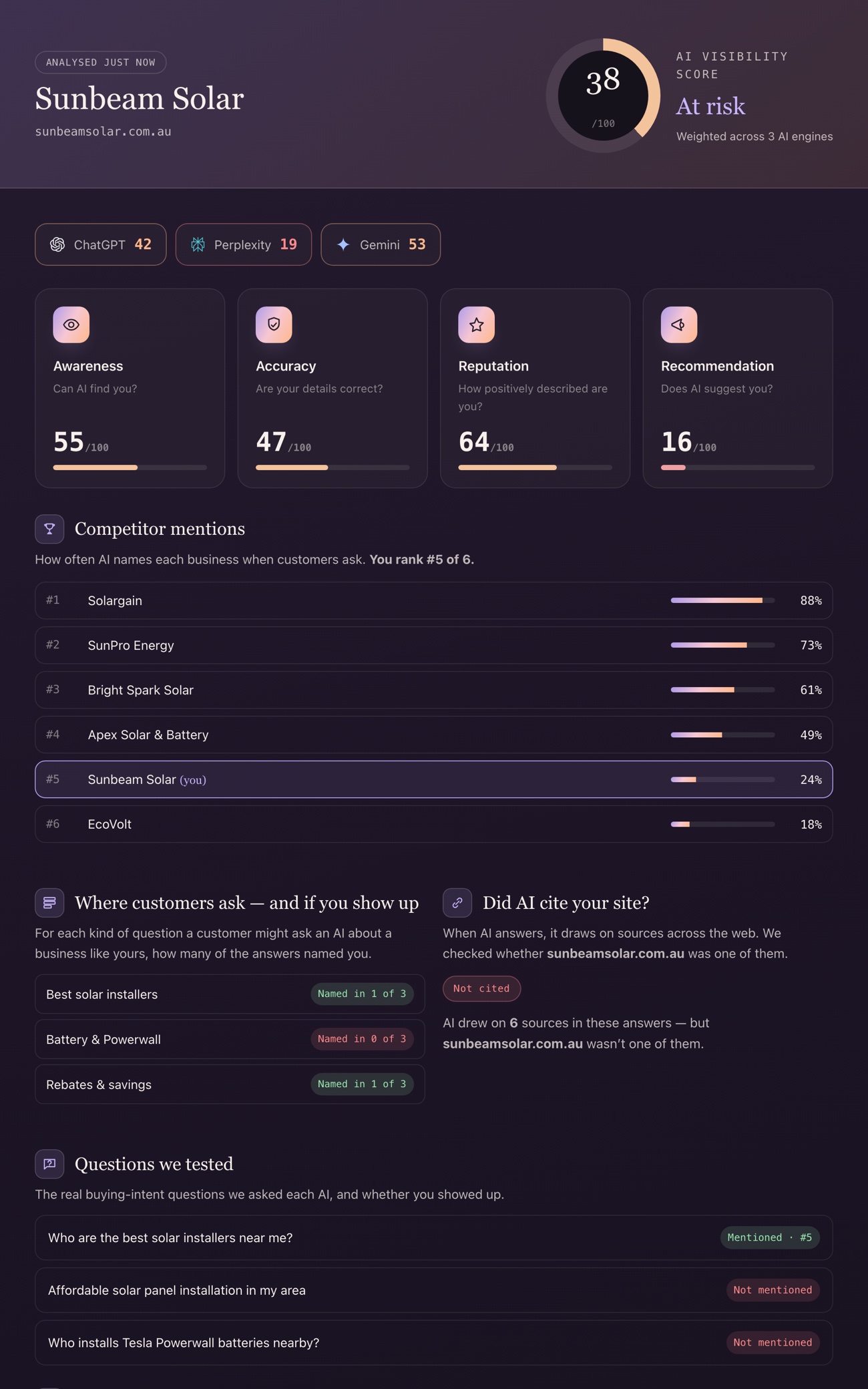
Not sure where your facts are wrong? Our free AI Visibility Audit asks the engines about your business and shows you what they get right and wrong.
Keeping your facts right over time
One thing I want to be honest about: this isn't a set-and-forget job. AI answers shift as models update and as the web changes around you. A new directory might scrape an old number. A model refresh might pull in something stale. Fixing your facts once gets you clean today – staying clean is a habit.
The habit is simple. Every few months, ask the AI engines about your own business the way a customer would, and check three things: is the name right, are the contact details right, and are the services and hours right? If something's drifted, trace it back to the source that's wrong and correct it there. Over time you'll notice it happens less, because a business the AI has learned to trust is one it stops second-guessing.
One warning: a wrong AI answer costs you silently. Nobody emails to say "the AI gave me the wrong number, so I called your competitor." You just never hear from them. That's why it's worth checking on purpose, before a quiet month tells you something you'd rather have caught early.
If you'd rather see the whole picture in one go – every place AI gets you wrong, across ChatGPT, Gemini and Perplexity, with a plain-English fix list – that's precisely what our free AI Visibility Audit is built to show you.