 By Danielle Evaland
First: this is common, not personal
If you've asked ChatGPT for a business like yours and watched it name a competitor instead of you, the first thing to know is that you're in very good company. This happens to most businesses, and it stings in a specific way, because it feels like a public verdict on your work. It isn't. It's a verdict on how easy you are to read.
Here's the scale of it. When SOCi's 2026 Local Visibility Index tested nearly 350,000 business locations, ChatGPT recommended just 1.2% of them. The same businesses appeared in Google's local map pack 35.9% of the time. So the AI is naming a tiny fraction of who Google would show, which means the few it does name effectively take the whole shelf, and everyone else is invisible.
And the stakes are real, not hypothetical. BrightLocal's 2026 survey found 45% of consumers now use AI to find a local business, up from just 6% a year earlier, making AI the third most-used discovery channel behind Google and Facebook. So when the AI picks your competitor, a real customer is being pointed at their door, not yours – and you never see it happen.
Reframe it: your competitor didn't beat you at being good. They got picked because they were the easier business for the AI to say yes to. That's a very different problem, and a fixable one.
How AI decides who to name
An AI doesn't visit your shop, try your service, or weigh up who's genuinely the best. It can't. What it does is read what's written about businesses like yours across the web, then repeat the option it can describe most confidently. When it's choosing who to name, a handful of things carry almost all the weight.
- Can it read them clearly? A website where the key facts are in plain text, not buried in images or heavy scripts, is easy for AI to lift. A competitor with a simple, readable site has a head start you can't see.
- Do their facts agree everywhere? When a business shows the same name, address, phone, hours and services across its site, Google, Facebook and directories, the AI trusts it. Conflicting details make the AI unsure, and unsure businesses get skipped.
- Do others vouch for them? Real reviews and mentions on pages the AI already trusts – Google, respected directories, community sites – are the AI's version of word of mouth. They tell it a business is real and reliable.
- Do they answer the actual question? A competitor whose site plainly says what they do, where, and for whom is easy to match to a customer's request. Marketing fluff isn't.
AI names the business it can read, verify and trust most easily. Your competitor probably isn't doing anything clever. They're just easier for the AI to be confident about than you are.
So why is it picking them?
Put those factors side by side and the gap usually becomes obvious. In my experience, the businesses that lose to a competitor in AI answers are rarely worse at the actual job. They're just relying on the things that used to win, while their competitor happens to have the things AI reads.
| Wins you customers in person | Wins you the AI's recommendation | |
|---|---|---|
| Quality of work | Everything | The AI can't see it |
| Word of mouth | Huge | Only if it's written down online |
| A stylish website | Impressive | Useless if AI can't read the text |
| Consistent details everywhere | Barely noticed | Critical |
| Reviews and mentions online | Helpful | Decisive |
The most common version I see: a genuinely excellent business with a beautiful, image-heavy website that an AI can barely read, and a slightly-less-good competitor with a plain, clear site, tidy Google profile and a steady trickle of reviews. To a human, you win. To the AI, they win, because they gave it something to hold onto and you didn't.
Watch for this one: the fancier your website looks, the more likely its important words are locked inside images and animations that AI can't read. Good-looking and AI-readable are not the same thing, and the gap catches out your best-presented businesses first.
Does that mean they're better?

No. And this is the part I most want you to hear, because it's the difference between feeling defeated and feeling motivated. The AI has no idea whether your competitor does better work than you. It literally cannot tell. It has never seen a finished job from either of you. What it can tell is which of you is easier to read, verify and describe – and it treats that as the answer to a completely different question.
AI doesn't recommend the best business. It recommends the most legible one. Those are only the same business by accident.
Danielle Evaland, Founder of EvaraThat should be a relief. If the AI were somehow judging quality and picking your competitor, that would be a hard problem. But it's judging clarity, and clarity is something you can fix in a few focused weeks. The businesses that understand this early get to quietly overtake competitors who are still assuming their good reputation will carry them. It won't, not with a reader that can't see reputation unless it's written down.
How to see exactly why they win
Guessing at the gap is frustrating. Seeing it is oddly satisfying, because it turns a vague worry into a short list of fixes. Here's how to see it clearly.
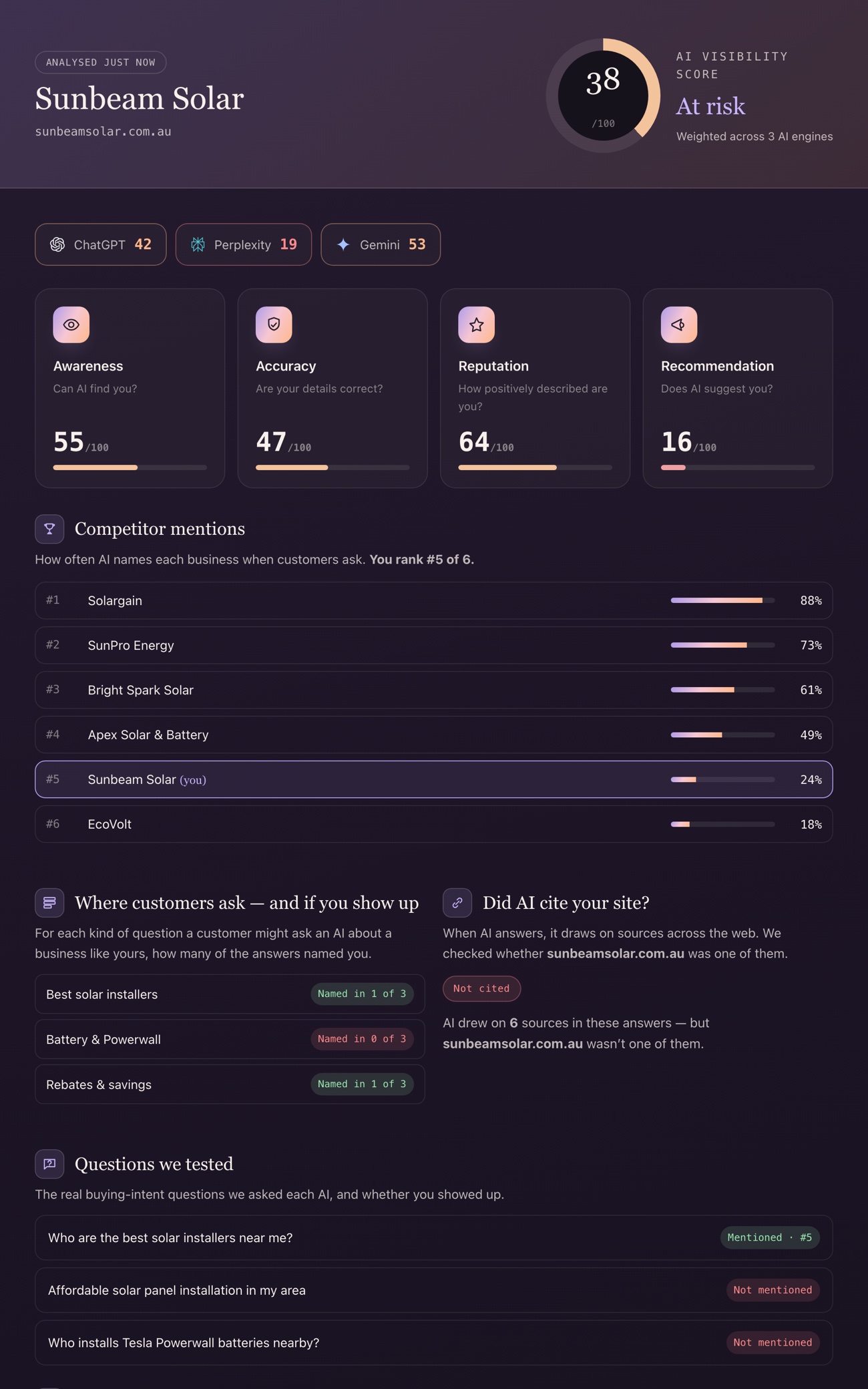
If you'd rather not piece it together by hand, this is exactly what our free AI Visibility Audit shows: it asks the engines about your business the way a customer would, then hands you a competitor leaderboard – who's being recommended ahead of you and why – in about 60 seconds. It's the fastest way to turn "they keep beating me" into a specific to-do list. You can also do the first, by-hand version any time with our guide on how to find out what AI says about your business.
How to close the gap
Once you can see why your competitor is winning, closing the gap is mostly a matter of doing the unglamorous things well. None of it is clever. All of it compounds.
- Make your website readable to AI. Get your key facts into plain text the AI can actually lift. This is usually the single biggest lever.
- Make your details identical everywhere. Same name, address, phone, hours and services on your site, Google, Facebook and every directory. Fix the conflicts that make AI unsure.
- Build reviews and mentions. Ask happy customers to leave reviews, and get listed and talked about on the trusted sites in your industry.
- Answer real questions in plain words. Write the way your customers ask, so the AI can match you to their question and quote you cleanly.
Do those, keep checking what the AI says over the following weeks, and you'll usually watch yourself climb into answers you were shut out of. If you want the full playbook on the first and most important fix, it's here: how to get your business to show up in ChatGPT. And if you'd rather hand the whole thing over, that's what we do – starting with the free audit, so you can see the gap before you spend a cent.