 By Danielle Evaland
Why this matters for dentists now
Choosing a dentist is a high-trust decision, and for a lot of people a slightly nervous one. So they check before they book. What's changed is where the checking happens: instead of scrolling a page of Google results, more and more people now open ChatGPT or Gemini and ask, "Who's the best dentist near me?", "Is this practice any good?", or "Where can I get an emergency dentist today?" The answer they get shapes who gets the call.
Put two numbers side by side and the shift is obvious.
So AI is now a real part of how patients choose, and they act on what it says – yet AI names barely one business in a hundred when asked. In SOCi's 2026 study of around 350,000 locations, businesses appeared in Google's local pack about 36% of the time but were recommended by ChatGPT only 1.2% of the time, and SOCi estimates AI visibility is three to thirty times harder to win than a normal local ranking. Patients already lean heavily on reviews for this decision – in one 2023 survey of around 1,100 Americans, more than eight in ten said they use online reviews to help choose a dentist (Dentaly). Dental search is also intensely local and often urgent, so being the practice AI confidently names for a specific treatment in a specific area is worth a great deal.
How AI picks which practice to name
AI doesn't check your clinical outcomes or read your case notes. It reads what the web says about dental practices in an area and repeats the option it can describe most confidently. For dentistry specifically, a few signals do most of the deciding.
- Clear registration and credentials. Being a registered, qualified dentist is the baseline trust fact. A practice that states it plainly is far easier to recommend than one that leaves AI guessing.
- Reviews and directory presence. Genuine reviews on Google, and claimed listings on the health directories AI trusts, weigh heavily in who it names.
- Stated treatments and who you serve. The treatments you offer and the patients you serve best – implants, Invisalign, emergencies, nervous patients, children – let AI match you to a specific query instead of a competitor.
- A website it can read. If your treatments, location and hours live inside images or a booking widget, AI struggles to see them. Plain, structured text wins.
People don't ask AI for "a dentist." They ask for "an emergency dentist open now near me" or "a dentist for nervous patients who does implants in Leeds." Visibility in dentistry is won per treatment and per area – and narrow is far easier to win than generic.
Registration, reviews and the directories
Here's where dentists have an edge a lot of local businesses don't. Two of AI's favourite things – hard credentials and structured, trusted directories – are things your profession is rich in. The problem is that most practices bury them.
First, registration and credentials, stated plainly. These are exactly the verifiable facts AI loves to lift into a recommendation. In the US, that's your state dental board licence and, if you hold it, American Dental Association membership. In Australia, every dentist must be registered with the Dental Board of Australia through AHPRA, and many belong to the Australian Dental Association. In the UK, every dentist must be registered with the General Dental Council. Put the registration and qualifications in readable text on your site, not just a certificate on the wall.
The health-directory edge: patients and AI both lean on structured directories built for healthcare. Healthgrades, Zocdoc and Opencare in the US, and the NHS find-a-dentist service in the UK, are structured, reviewed listings that AI already treats as trustworthy. So are the profession's own tools: the ADA Find-a-Dentist (US) and the Australian Dental Association's find-a-dentist. A claimed, complete, well-reviewed profile on the one or two your patients actually use reinforces everything else.
Second, the public register. AHPRA's register in Australia, the GDC register in the UK, and your state board in the US are authoritative sources that confirm you are who you say you are. Being present and correct in them is a quiet but strong trust signal that supports everything on your own site.
Reviews and the advertising rules
This is where dentistry needs a bit more care than most local businesses, and it's worth getting right rather than guessing. Reviews are one of the strongest signals AI uses, but dentistry is a regulated health service, and there are rules about how you can use them in your advertising. The rules differ by country, so here's the honest version for each.
- Australia. Under the National Law, AHPRA's advertising guidelines prohibit using testimonials about clinical care in advertising a regulated health service. In practice, that means you should not curate or republish clinical testimonials in your own marketing, but you can still collect genuine Google reviews, which feed local and AI visibility and which you are not "advertising" by controlling. If unsure, check the current AHPRA guidance or your own advice.
- United Kingdom. Genuine testimonials are permitted, but under the ASA/CAP advertising code and GDC guidance they must be truthful, substantiated and not misleading.
- United States. Reviews and testimonials are allowed, but under FTC rules and your state dental board they must be genuine and not deceptive – no fake or incentivised reviews.
The common thread everywhere is the same: honest reviews you have gathered fairly are good for both patients and AI visibility. The line you must not cross is manufacturing them, or, in Australia, building clinical testimonials into your own advertising. None of this stops you asking happy patients to leave a genuine Google review – that remains one of the best things you can do.
What most dental websites get wrong

Most dental websites make the same mistake: they're built to look reassuring and to push the "book now" button, but they say very little that's specific. A calm hero image, a smiling team photo, "general and cosmetic dentistry," and a booking widget. It works for a person skimming on their phone, and to an AI it's nearly invisible, because there's no treatment detail, no location text, and often no registration in words to latch onto. When someone asks AI for "a dentist who does dental implants for anxious patients in my area," a practice that never wrote those words simply can't be matched.
The fix is to get specific in plain language: the treatments you offer, the patients you're great with, whether you handle emergencies, the areas and suburbs you serve, your registration and qualifications, your hours, and clear answers to the questions patients actually ask. You don't have to sound clinical – you just have to name what you do, so AI has something concrete to recommend you for. We cover the how in how to make your website readable to AI.
A calm, reassuring dental site can still be invisible to AI. "General and cosmetic dentistry" gives the machine nothing specific to recommend you for.
Danielle Evaland, Founder of EvaraThe steps to get into AI answers
Here's the order I'd work in if you run a dental practice and want to start being named. None of it is complicated; it's about giving AI clear, consistent, trusted information to work with, within your rules.
Where to start
Start by finding out where you actually stand, because it's free and it tells you how big the gap is. Ask ChatGPT, Perplexity and Gemini for the best dentist in your area for the treatments you want more of – "dental implants," "emergency dentist," "Invisalign," "dentist for nervous patients" – and see whether you're named, whether your treatments and registration are right, and which practices keep coming up instead. Try it a few different ways, since patients phrase it differently and each engine draws on different sources. That five-minute check turns a vague worry into a clear, ranked list of what to fix first.

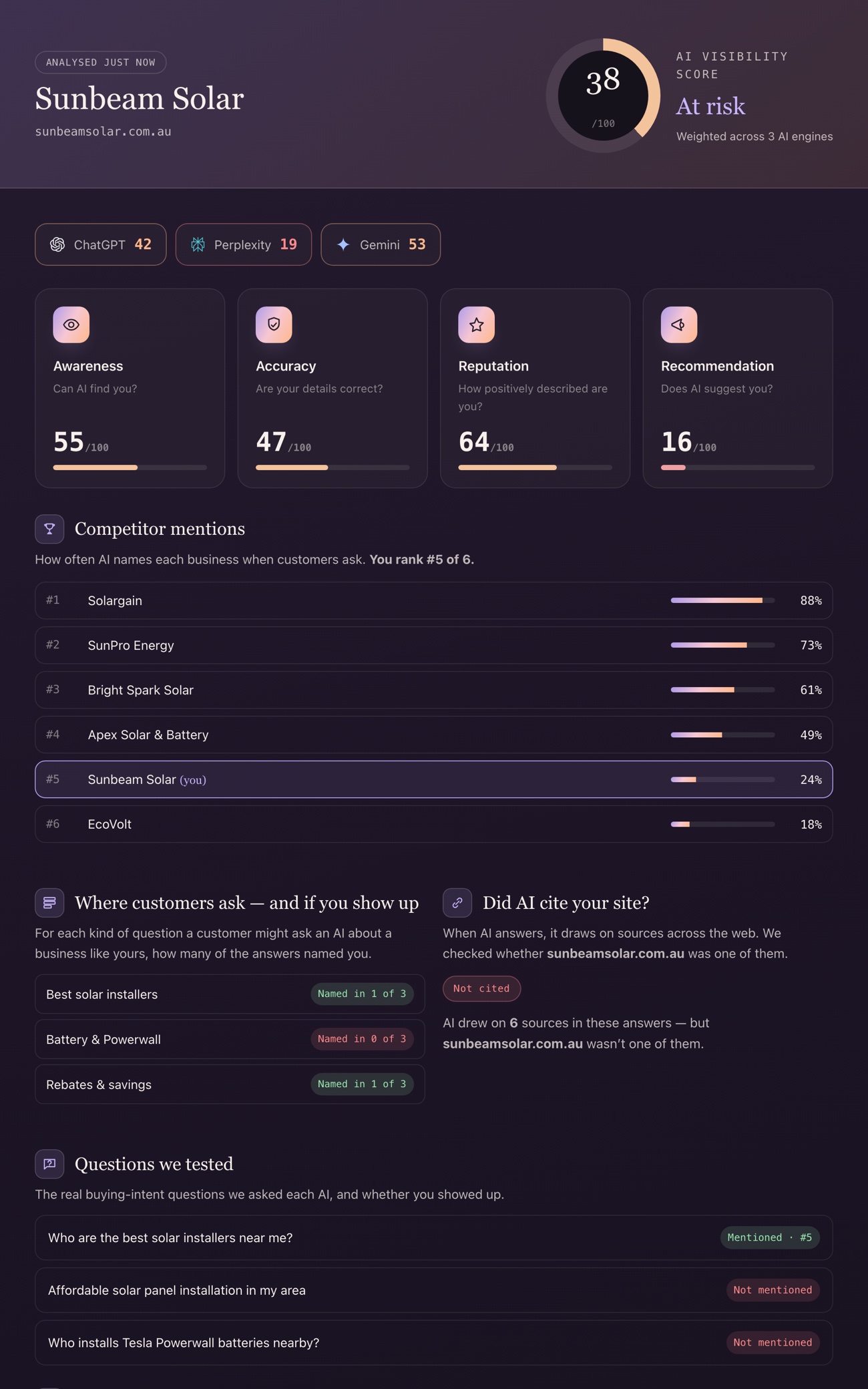
If you'd rather see it scored properly across every engine – with the practices named ahead of you and the specific fixes ranked by impact – that's exactly what our free AI Visibility Audit does in about 60 seconds. Because a patient is often a long, recurring relationship, being the practice AI confidently names for your treatments and area is one of the highest-value marketing moves you can make – and most of your competitors haven't started.
One more thing for dental practices: accuracy matters as much as visibility. If AI has your treatments, hours or location wrong, it can send patients the wrong way or misdescribe your practice. If that's a worry, start with why AI gets your business facts wrong.