 By Danielle Evaland
Why this matters for accountants now
Choosing an accountant is a high-trust decision that people don't take lightly, because it's usually an ongoing relationship, not a one-off job. Most of that trust still starts with a personal recommendation. But what happens straight after the referral has changed: people open ChatGPT or Gemini and ask, "Is this firm any good?" or "Who's the best accountant for a small business like mine?" The answer they get shapes who they actually call.
Put two numbers side by side and the shift is obvious.
So AI is now a real part of how firms get chosen, and people act on what it says – yet AI names barely one business in a hundred when asked. In SOCi's 2026 study, businesses appeared in Google's local pack about 36% of the time but were recommended by ChatGPT only 1.2% of the time. Accounting is also a field where specialisation pays: in one 2025 survey of US businesses, most found their accountant through a referral and only 3% through advertising, yet firms said they'd pay up to 25% more for a specialist who fits their niche (CPA Practice Advisor). Being the specialist AI confidently names, for a specific niche in a specific place, is a durable, premium relationship worth winning.
How AI picks which firm to name
AI doesn't review your workpapers or judge your advice. It reads what the web says about accounting firms in an area and repeats the option it can describe most confidently. For accounting specifically, a few signals do most of the deciding.
- Clear credentials. Your qualifications and registrations tell AI you're legitimate. A firm that states them plainly is far easier to recommend than one that leaves AI guessing.
- Reviews and directory presence. Genuine reviews on Google, and claimed listings on the advisor directories AI trusts, weigh heavily in who it names.
- A stated specialisation. The niche and the clients you serve best – e-commerce, tradespeople, self-employed, medical – let AI match you to a specific query instead of a competitor.
- A website it can read. If your services, credentials and niche live inside images or a dense one-pager, AI struggles to see them. Plain, structured text wins.
People don't ask AI for "an accountant." They ask for "an accountant for a self-employed tradie in Leeds" or "a CPA for an e-commerce business in Texas." Visibility in accounting is won per specialisation and per city – and narrow is far easier to win than generic.
Credentials and the directories built for you
Here's where accountants have an edge most local businesses don't. Two of AI's favourite things – hard credentials and structured, reviewed directories – are things your profession is rich in. The problem is that most firms bury them.
First, credentials, stated plainly. These are exactly the verifiable facts AI loves to lift into a recommendation. In Australia, that's your CPA, CA or IPA designation and your Tax Practitioners Board registration as a registered tax or BAS agent. In the US, it's your CPA licence or your IRS Enrolled Agent status. In the UK, it's ICAEW, ACCA, CIMA or AAT. Put the letters and the registration in readable text on your site, not just a logo in the footer – they're among the strongest trust signals you have.
The accounting-only edge: the software-advisor directories. The Xero Advisor Directory and QuickBooks ProAdvisor "Find an Accountant" are structured, credential-and-review-backed listings built specifically for accountants – no other trade has anything like them. They carry a certification badge and reviews, which is exactly the "certified, near me, reviewed" combination AI wants. Claiming and completing them is one of the highest-value hours an accounting firm can spend.
Second, your professional body's directory. ICAEW's "Find a Chartered Accountant," CPA Australia's and CA ANZ's member finders, and the IRS directory of credentialed preparers are authoritative, credential-backed listings AI already treats as trustworthy. Being present and correct in them reinforces everything else.
What most accounting websites get wrong

Most accounting websites make the same mistake: they try to appeal to everyone, so they say almost nothing specific. "Tax, bookkeeping, advisory, for businesses of all sizes." It reads as safe and professional, and to an AI it's nearly invisible, because there's no niche, no location detail, and often no credentials in text to latch onto. When a business asks AI for "an accountant who understands e-commerce," a firm that never said it works with e-commerce simply can't be matched.
The fix is to get specific in plain language: the industries and client types you serve best, the qualifications your team holds, the software you specialise in, the locations you cover, and clear answers to the questions your ideal clients actually ask. You don't have to abandon general work – you just have to name what you're known for, so AI has something concrete to recommend you for. We cover the how in how to make your website readable to AI.
The safest-sounding accounting sites are often the most invisible to AI. "We help all businesses" gives the machine nothing specific to recommend you for.
Danielle Evaland, Founder of EvaraThe steps to get into AI answers
Here's the order I'd work in if you run an accounting or bookkeeping firm and want to start being named. None of it is complicated; it's about giving AI clear, consistent, trusted information to work with.
Where to start
Start by finding out where you actually stand, because it's free and it tells you how big the gap is. Ask ChatGPT, Perplexity and Gemini for the best accountant in your city for the kind of clients you want, and see whether you're named, whether your credentials and niche are right, and which firms keep coming up instead. Try it a few different ways, since businesses phrase it differently and each engine draws on different sources. That five-minute check turns a vague worry into a clear, ranked list of what to fix first.
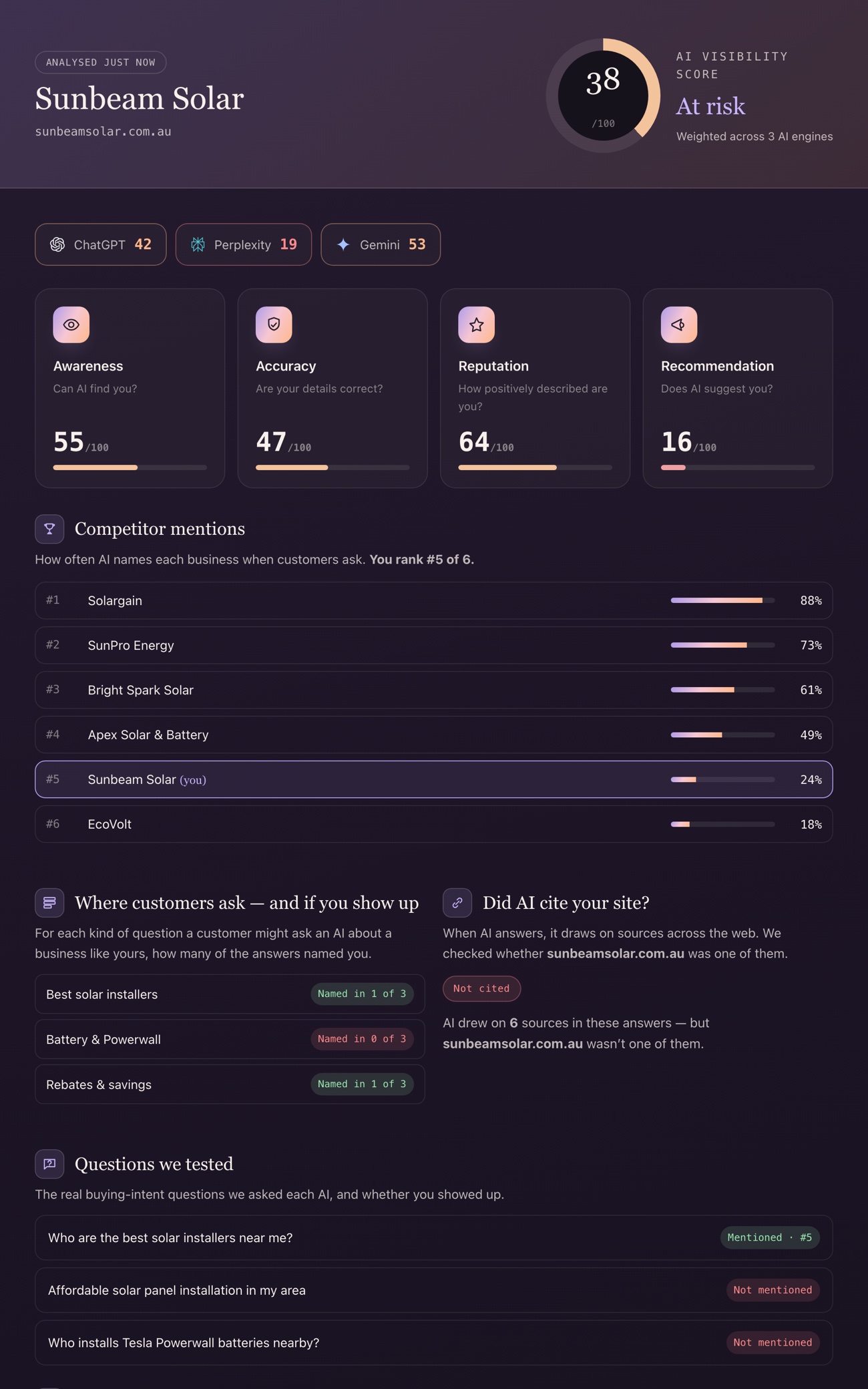
If you'd rather see it scored properly across every engine – with the firms named ahead of you and the specific fixes ranked by impact – that's exactly what our free AI Visibility Audit does in about 60 seconds. Because an accounting client is usually a long, recurring relationship, being the firm AI confidently names for your niche is one of the highest-value marketing moves you can make – and most of your competitors haven't started.
One more thing for accountants: accuracy matters as much as visibility. If AI has your qualifications or specialisation wrong, it can send the wrong clients your way or misdescribe your firm. If that's a worry, start with why AI gets your business facts wrong.