 By Danielle Evaland
Why law is a different search entirely
Hiring a lawyer isn't like booking a plumber. It's a high-stakes, often stressful decision, and people research it hard before they pick up the phone. What's changed is where that research now starts. Instead of scrolling Google, more and more people open ChatGPT or Gemini and simply ask: "Who's the best family lawyer near me?" or "Is this firm any good?" The answer they get shapes the shortlist before a single call is made.
And this shift is happening faster in law than almost anywhere. In a July 2026 study of 1,110 US consumers, iLawyer Marketing found ChatGPT had become the second most common way people research an attorney, with the share saying they'd use it climbing from 9% in 2023 to nearly 42% in 2026. Look at the numbers next to each other.
Now put the first and last numbers together. Half of legal buyers will use AI in their search, but AI recommends barely one business in a hundred when asked. In SOCi's 2026 study of nearly 350,000 businesses, they showed in Google's local pack about 36% of the time but were recommended by ChatGPT only 1.2% of the time. For a firm that already spends heavily on Google Ads and SEO, that's a hard truth: none of that spend guarantees you appear when a client asks AI. And roughly one in ten of those legal buyers said they'd use AI sources only – if you're invisible there, they never see you at all.
How AI picks which firm to name
AI doesn't read your case files or judge your advocacy. It reads what the web says about law firms in an area and repeats the option it can describe most confidently. For law specifically, a handful of signals do most of the deciding.
- Reviews, and the ratings attached to them. Legal work is high-trust, so AI leans hard on reputation. Genuine reviews on Google and the legal directories weigh heavily in who it names.
- Directory presence. Law has strong, established directories AI already trusts. A firm listed and reviewed there is far easier to surface than one that isn't.
- Clear practice areas and jurisdiction. AI needs to know exactly what you do and where you're licensed. A firm that states this plainly is easy to match to a specific query; one that doesn't gets skipped.
- A website it can read. If your practice areas and locations live inside sliders, PDFs or a single dense page, AI struggles to see them. Plain, structured text wins.
Nobody asks AI for "a lawyer." They ask for "a family lawyer in Leeds" or "a personal-injury attorney in Houston." Visibility in law is won per practice area and per city. Being famous for one won't carry you into another.
Reviews, credentials and the rules
Here's the tension that makes law unusual. Reviews are among the strongest signals AI uses, and legal buyers weight them heavily too. Yet law is also the profession most tightly regulated on how it can advertise and use testimonials. So the very asset AI leans on is the one you're most restricted in manufacturing – which is actually good news, because it means genuine reviews are a real, defensible edge for the firms that earn them properly.
The rules are worth knowing, and they vary by country. In the US, client communications fall under your state bar's version of Model Rule 7.1 (nothing false or misleading), and since October 2024 the FTC's rule on fake reviews bans buying, faking or incentivising reviews across every industry, with serious per-violation penalties. In Australia, the Solicitors' Conduct Rules bar false, misleading or deceptive marketing, and some states restrict personal-injury advertising specifically. In the UK, the SRA requires publicity to be "accurate and not misleading," and testimonials to be genuine and consented-to.
The compliant way to win here: ask every satisfied client for a Google review, get consent before you feature a testimonial, never edit or buy them, and add a "past results don't guarantee future outcomes" line wherever a review mentions a specific result. Real reviews, collected properly, are exactly what AI wants to see – and what your competitors often cut corners on.
The second load-bearing signal is credentials, stated plainly: your bar admissions, the jurisdictions you're licensed in, your practice areas, and any accredited-specialist status (a regulated term you can only use if you genuinely hold it). These aren't just trust-builders for a nervous client. They're the facts AI uses to decide you're the legitimate, correctly-qualified firm for a specific problem in a specific place – and to avoid recommending the wrong-jurisdiction or wrong-specialty firm, which is a real failure mode it's cautious about.
What most law firm websites get wrong

Law firm websites tend to fall into two traps. The first is the polished-but-empty site: a striking hero image, a mission statement, and very little of the concrete information AI needs – which states you're licensed in, which exact practice areas you cover, what you'll charge to have a conversation. The second is the everything-on-one-page site, where family law, criminal defence, conveyancing and estate planning all share a single wall of text, so AI can't cleanly match you to any one of them.
The fix is the same in both cases: give each practice area its own clear page, written in plain language, naming the location it serves and the questions clients actually ask. State your admissions and jurisdictions in text, not just a logo wall of bar association badges. Keep the elegant design – just don't let it be the only place your facts live. We cover the how in how to make your website readable to AI.
The most impressive law firm sites are often the most invisible to AI. Reassuring to a worried client, and blank to the machine deciding whose name comes up first.
Danielle Evaland, Founder of EvaraThe steps to get into AI answers
Here's the order I'd work in if you run a firm and want to start being named. None of it is complicated, and all of it stays inside the advertising rules if you keep the reviews genuine.
Where to start
Start by finding out where you actually stand, because it's free and it tells you how big the gap is. Ask ChatGPT, Perplexity and Gemini for the best lawyer in your city for the work you do, and see whether you're named, whether your practice areas and jurisdiction are right, and which firms keep coming up instead. Try it a few different ways, since clients phrase it differently and each engine draws on different sources. That five-minute check turns a vague worry into a clear, ranked list of what to fix first.
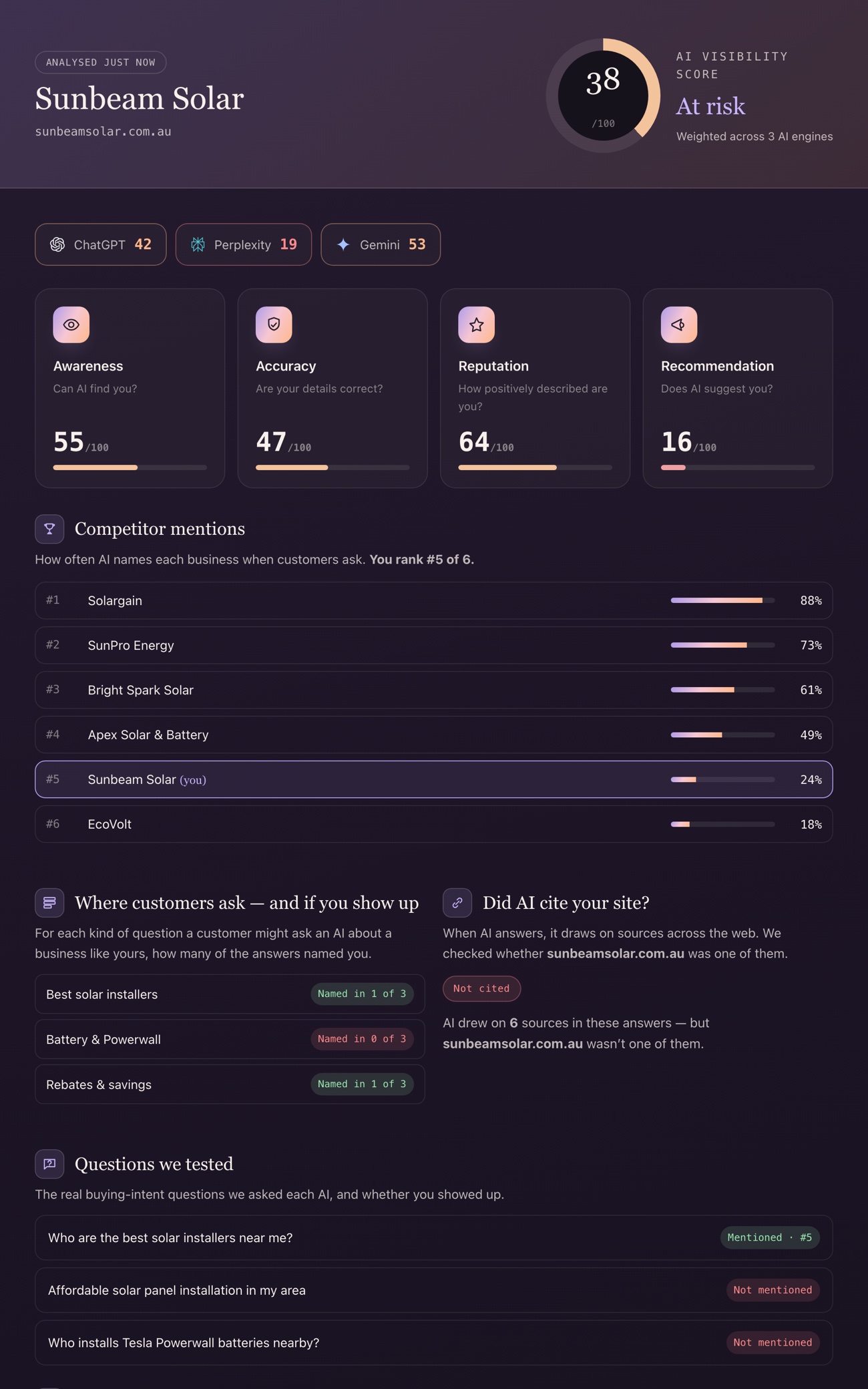
If you'd rather see it scored properly across every engine – with the firms named ahead of you and the specific fixes ranked by impact – that's exactly what our free AI Visibility Audit does in about 60 seconds. In a profession where one won matter can be worth many thousands, being the firm AI confidently names is a genuine advantage, and right now most of your competitors haven't started.
One more thing for law: accuracy is everything here. If AI has your jurisdiction or a practice area wrong, it can send a client to the wrong firm – or misdescribe yours. If that's a worry, start with why AI gets your business facts wrong.