 By Danielle Evaland
Why broking is built for this
A mortgage is the largest financial commitment most people ever make, and they make it rarely. So they research it hard – and that research increasingly starts with a question typed into AI: "Should I use a mortgage broker or go straight to the bank?" or "Who's the best broker near me?" The answer they get shapes who they even consider.
Here's what makes broking almost tailor-made for AI visibility. In Australia, using a broker is already the norm, not the exception.
Brokers settled a record 76.7% of new residential home loans in the December 2025 quarter, according to MFAA data – the channel most borrowers already choose. The UK is similar, with around nine in ten mortgages arranged through an intermediary. So the demand to "find a broker" is enormous. The catch is the last number: AI recommends barely one business in a hundred when asked. In SOCi's 2026 study, businesses appeared in Google's local pack about 36% of the time but were recommended by ChatGPT only 1.2% of the time. Huge demand, tiny recommendation window – that's a gap worth closing.
How AI picks which broker to name
AI doesn't compare your interest rates or your service. It reads what the web says about brokers in an area and repeats the option it can describe most confidently. For broking specifically, a few signals do most of the deciding.
- Reviews, and lots of them. A mortgage is high-trust and high-value, so AI leans hard on reputation. Reviews on Google and on the broker platforms buyers trust weigh heavily in who it names.
- A stated licence and duty. Your credit licence, NMLS number or FCA authorisation tells AI you're legitimate. State it in text and you're easier to recommend than a broker who leaves AI guessing.
- Clear area and specialisation. The region you serve and who you help most – first-home buyers, self-employed, refinancers – lets AI match you to a specific borrower's question instead of a competitor's.
- A website it can read. If your services and area live inside a slick calculator or hero banner, AI can't see them. Plain text wins.
In broking, trust is the currency. AI recommends the broker it can verify is licensed, well-reviewed and local – not necessarily the one with the sharpest rates. Give it clear, consistent, trusted information and you become the name it repeats.
The credential you can state plainly
Brokers have an advantage most trades don't: a formal, citable duty or licence that sets you apart from a bank – and it's the kind of hard fact AI loves to lift straight into a recommendation. The problem is that most broker sites bury it.
In Australia, brokers have been bound by a statutory Best Interests Duty since 1 January 2021, under ASIC's Regulatory Guide 273 – a legal obligation to act in the borrower's best interests that banks are not subject to. That's a genuine differentiator worth stating in plain words. In the US, every licensed loan originator has a verifiable NMLS number under the SAFE Act, and in the UK brokers are FCA-authorised. Whichever market you're in, that credential is a trust fact – put it in readable text on your site and your profiles, not hidden in a footer or a compliance PDF.
Broker-specific edge: "Should I use a broker or go to the bank?" is one of the exact questions borrowers ask AI. A page that answers it plainly – access to a whole lender panel, usually no cost to the borrower, one application instead of many – positions you to be the named answer, especially when your Best Interests Duty or licence is right there in the text.
What most broker websites get wrong

Broker websites tend to lead with a slick repayment or borrowing-power calculator and a big "get started" button, and not much else. It looks modern and useful – but the calculator is a script AI can't read, and the facts that actually matter (where you work, the lenders on your panel, your licence, who you specialise in helping) often aren't written anywhere in plain text. Your site looks sharp to a borrower and nearly blank to an AI.
The fix isn't to drop the calculator. It's to make sure the important facts also exist in readable text: your service area written out, your lender panel or the fact you compare a wide range of lenders, your credit licence or NMLS or FCA details, who you help most, and clear answers to the questions borrowers actually ask. Keep the polished tools; just don't let them be the only place your information lives. We cover the how in how to make your website readable to AI.
The busiest-looking broker sites are often the most invisible to AI. A beautiful calculator, and not one readable sentence about who you are or where you work.
Danielle Evaland, Founder of EvaraThe steps to get into AI answers
Here's the order I'd work in if you're a broker who wants to start being named. None of it is complicated; it's about giving AI clear, consistent, trusted information to work with.
Where to start
Start by finding out where you actually stand, because it's free and it tells you how big the gap is. Ask ChatGPT, Perplexity and Gemini for the best mortgage broker in your area and see whether you're named, whether your details are right, and which brokers or banks keep coming up instead. Try it a few different ways, since borrowers phrase it differently and each engine draws on different sources. That five-minute check turns a vague worry into a clear, ranked list of what to fix first.
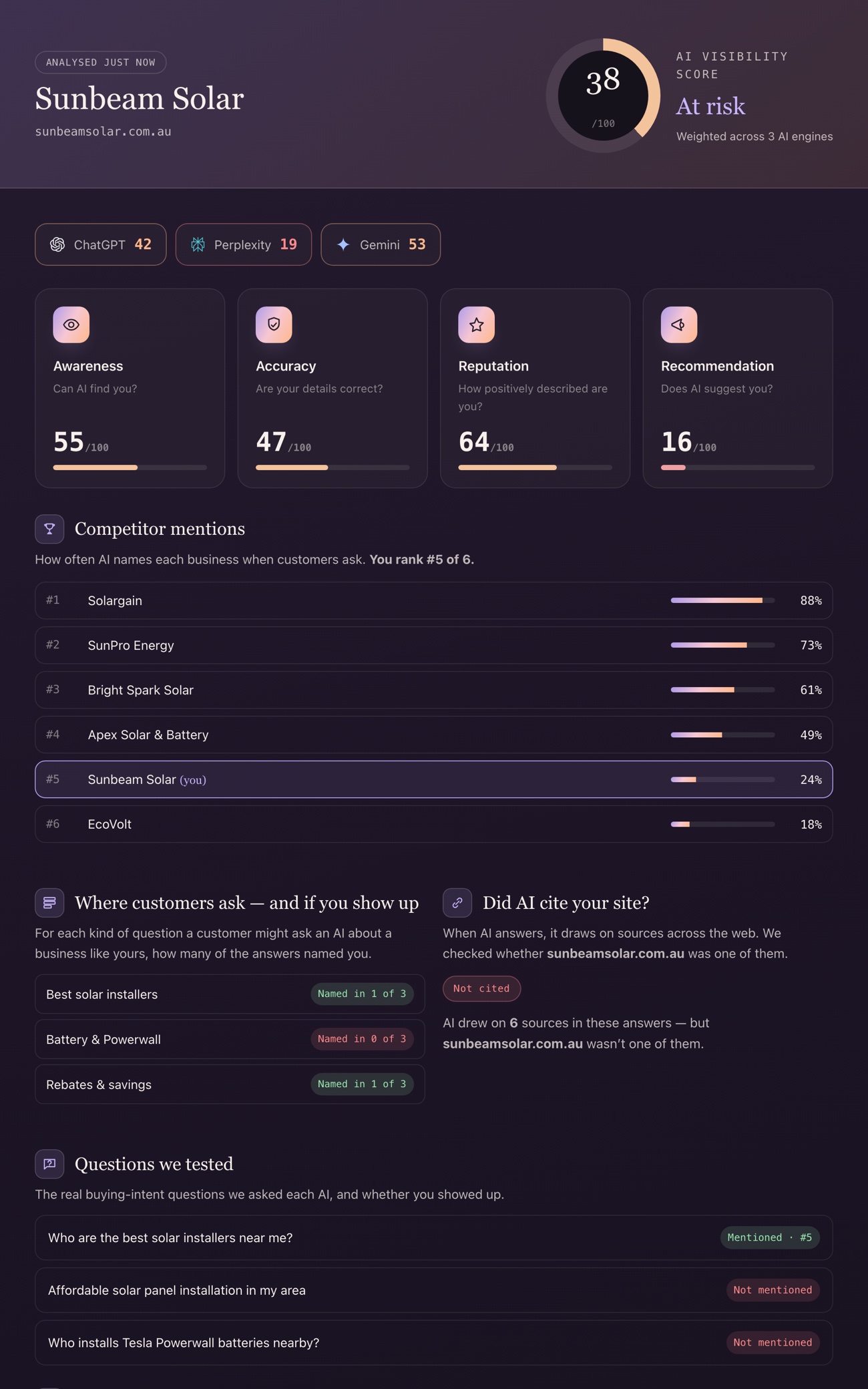
If you'd rather see it scored properly across every engine – with the competitors named ahead of you and the specific fixes ranked by impact – that's exactly what our free AI Visibility Audit does in about 60 seconds. With most borrowers already choosing brokers and more of them starting in AI every month, being the broker AI confidently names is a genuine head start – and most of your competitors haven't taken it yet.
One more thing for brokers: speed wins loans. Borrowers comparing brokers contact several at once, so being named by AI and replying within minutes is how you win the deal. If you want to see what AI says first, check what AI says about your business.