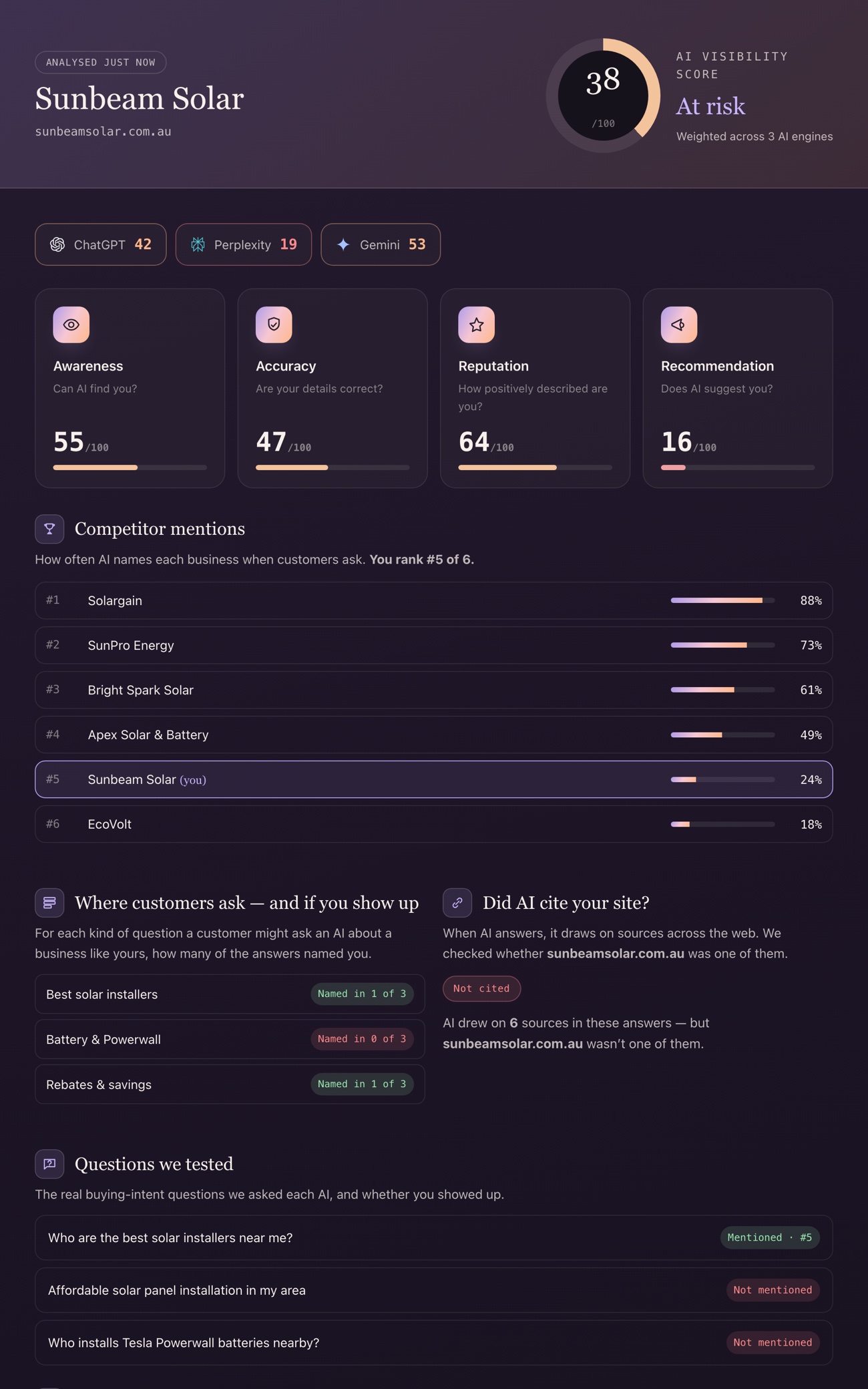
 By Danielle Evaland
Does AI actually name small businesses?
This is the question I get asked most, usually with a hopeful look. And the honest answer is: sometimes, and a lot less reliably than the big brands do. AI engines don't have favourites or gut feelings. They pattern-match on what they can read about you across the web. So a household name with thousands of clean, consistent mentions is easy for AI to recommend with confidence. A small local business with a thin website, a couple of reviews and a few conflicting phone numbers floating around? Much easier to skip.
You can see the tilt in the research. In one study of 50 buyer-intent prompts across ChatGPT, Perplexity and Gemini, a single well-known brand (HubSpot) turned up in 62% of all 150 answers and across 34 of the 50 topics. When one big name eats that much of the airtime, there's simply less room left for everyone else. That's the uphill part for a small business.
AI doesn't reward the best business. It rewards the most readable, most consistent, most-vouched-for business it can find. Small players lose visibility not because they're worse, but because they're harder for AI to read.
Here's the part that should give you hope, though. That same "readability tilt" is exactly why a small business can climb fast. You're not fighting a bigger ad budget. You're fixing whether AI can read you clearly, and that's a very different, very winnable game. We unpack the mechanics in what AI visibility actually means.
How many customers are already asking

Before we worry about whether AI names you, it's worth asking whether people are even using it to find businesses like yours. A year ago I'd have said "a few early adopters." Now the numbers say something very different.
Going from 6% to 45% in a single year is one of the fastest behaviour shifts I've ever seen in local search. To put it plainly: BrightLocal found AI has jumped into third place as a way people find local businesses, behind only Google and Facebook, ahead of Yelp and TripAdvisor. That's not a trend to "keep an eye on." That's a channel that already exists, whether or not your business is in it.
And these customers aren't blindly trusting the machine, which is actually good news for honest businesses. BrightLocal found 63% of active AI users trust AI recommendations, but 88% still fact-check them by looking at your reviews and sources. So the AI opens the door, and your real reputation closes the sale. Both have to be in order.
One question, three different answers
Here's the finding that surprises people most, and it's the single most important thing to understand about AI visibility. There is no such thing as "being visible to AI" as one score. Each engine reads the web its own way and reaches its own conclusions. Ask the same buying question of ChatGPT, Gemini and Perplexity and you'll often get three different sets of names.
In that 50-prompt study, across 150 answers and 277 distinct brands, the engines lined up far less than you'd expect:
| What they found | The number | What it means for you |
|---|---|---|
| All three named the same brand | Only 21% of the time | Winning one engine doesn't win the others |
| Mentions from a single engine only | 53% of all brand mentions | Over half of visibility lives on just one engine |
| Brands named per answer – ChatGPT | 15.3 | Casts the widest net, reaches the long tail |
| Brands named per answer – Gemini | 15.0 | Leans on Google's own ecosystem |
| Brands named per answer – Perplexity | 11.9 | Most conservative; grounds answers in live results |
Read that top row again. When you ask the three biggest AI engines the same buying question, they agree on a single business only about one time in five. That means you could be the top pick in ChatGPT and completely absent from Perplexity, described perfectly by one and wrongly by another. Your customers don't all use the same tool, so a gap on any single engine is a gap that's costing you real enquiries.
AI visibility isn't one score, it's several. You need to be readable and trustworthy enough that every major engine, reading the web its own way, still arrives at your name. Checking just one tool tells you almost nothing about the others.
What the research says moves the needle

So if the deck is tilted toward big, readable brands, what can a small business actually do about it? This is where the research gets genuinely encouraging. The original academic paper on this, from Princeton and IIT Delhi, tested roughly 10,000 queries and measured what made a source more likely to be cited in an AI answer. The lift was real and often large.
- Cite real sources and evidence. The Princeton study found that adding citations and outside sources boosted a lower-ranked page's visibility by as much as 115%. Facts AI can verify beat claims it has to take on faith.
- Add clear statistics and quotes. The same research showed well-placed data and direct quotes lifted visibility meaningfully. Overall, the strongest techniques improved a source's presence in AI answers by up to 40%.
- Be clear about who you are. Studies of what stays visible point to the same three traits again and again: a clear identity, content AI can easily lift out, and a presence across more than one place on the web.
- Show up in more than one place. A single tidy website isn't enough. Your facts need to agree across your site, Google, social profiles and directories, so every engine keeps meeting the same consistent story.
Notice what's missing from that list: a bigger budget, a cleverer slogan, being the oldest name in town. None of it helps if AI can't read your facts. What moves the needle is boring, honest housekeeping – clear content, real evidence, consistent details – and that's genuinely good news if you're small. If you want the how-to, start with how to get your business to show up in ChatGPT.
The most reassuring finding in all of it: the biggest visibility gains in the Princeton study went to lower-ranked pages that added evidence and clarity. In plain terms, the little guy has the most to gain.
Let's be honest: this data is still early
I want to be straight with you, because a lot of the AI-visibility world is not. Much of this research is new, and some of it is thin. That 50-prompt comparison is a small sample. Adoption surveys measure slightly different things from one year to the next. And AI answers genuinely wobble – ask the same question twice and you can get two different lists, which is part of why one industry roundup found only around 30% of brands hold steady visibility from one session to the next.
Treat today's numbers as a compass, not a map. They tell you the direction things are moving, not the exact spot you'll land.
Danielle Evaland, Founder of EvaraSo no, I'm not going to wave a single hero statistic at you and pretend it's settled science. What I will say is that every honest signal points the same way. Consumer use is climbing fast. Results vary wildly between engines. And businesses with clean, consistent, well-evidenced information get named more often. Those three things are steady even while the exact percentages move around.
One more bit of honesty: Evara hasn't run its own published study yet. Everything above comes from other people's research, credited in full at the bottom of this page. We're now scoring real businesses across every major engine through our own audits, and a future edition of this field note will add what we find. Until then, I'd rather point you to solid outside sources than dress up our opinion as data.
Don't over-read a single check. Because AI answers change, one search on one engine on one day is a snapshot, not a verdict. Real visibility is measured across engines, and watched over time.
How to see where you actually stand
Averages are interesting. What matters to you is your business, in your town, across the engines your customers actually use. The good news is you can get a rough read in ten minutes, for free, by doing exactly what your customers do.
If you show up strongly on one engine and vanish on another, now you know exactly which gap is costing you enquiries. And if you'd rather have it done properly – all the major engines, a clear score, and a plain-English fix list – that's precisely what our free AI Visibility Audit is built to do. It's the same measurement work behind the future edition of this guide, run on your business.