 By Danielle Evaland
The honest answer, no hype
You've probably seen the headlines: "Google is dead," "ChatGPT killed search," "the end of the ten blue links." It makes for a great click, but it's not quite true. Google isn't being replaced. It still runs the overwhelming majority of the world's searches, and there's no sign of that flipping overnight.
But here's the thing I don't want you to miss while everyone argues about whether Google is "dead" or not: the way people search has already changed, and it's changing under the same Google logo you've always known. You can be completely right that Google is still king and completely unprepared for how customers now use it.
AI isn't replacing Google. It's changing what "showing up on Google" even means – from ranking in a list of links to being named inside an answer.
So the useful question isn't "will Google die?" It's "where do my customers actually get their answer now, and is my business in it?" That's a question with a real, measurable answer – and it's the one your competitors haven't asked yet.
What the numbers actually say

Let's skip the opinions and look at what's really happening. Three numbers tell the whole story at once, and they pull in slightly different directions – which is exactly why this gets misreported.
See the tension? AI usage is exploding – 2 billion people a month meeting an AI answer inside Google, 800 million using ChatGPT every week. And at the same time, Google still holds around 90% of the search market. Both are true. That's why "Google is dead" and "nothing has changed" are both wrong.
The clearest way to size it up is by traffic. In June 2025, all AI platforms combined sent about 1.13 billion referral visits to the top websites – a huge number, up 357% in a year. Google Search sent about 191 billion in the same month. So AI is growing fast, but it's still a fraction of Google's scale. This is a shift in progress, not a finished coup.
The one-sentence read: AI search is growing very fast off a small base, while Google stays huge. You don't have to pick a winner – you have to be visible in both.
The plot twist: AI is now inside Google
Here's what trips most people up. They imagine the battle as "Google versus ChatGPT" – two separate boxes, and you just wait to see which one wins. But that's not what's happening. The biggest AI search product in the world isn't a Google rival. It's Google.
AI Overviews – that AI-written summary that now appears at the top of a huge share of searches – is Google's own feature. It's live in more than 200 countries. Google's boss has said it drives over 10% more searches for the kinds of queries where it shows up. So when someone "Googles" a plumber today, a growing number of the time they're reading an AI answer before they ever reach the old list of links.
The question was never Google versus AI. Google became AI. The list of links is quietly turning into a written answer with a couple of names in it.
Danielle Evaland, Founder of EvaraThis is why "is AI replacing Google?" is almost the wrong question. Google isn't being replaced by AI – it's becoming an AI answer engine itself, and dragging billions of everyday searches into that new format. The old blue links still exist, but for a lot of searches they're no longer where the decision gets made. The decision gets made in the answer at the top.
How the search journey has changed

The best way to feel the shift is to compare the old path to the new one. Same person, same question, completely different journey to a decision.
| Old search journey | AI-answer journey | |
|---|---|---|
| What they type | "plumber near me" | "who's the best emergency plumber near me?" |
| What they see first | A list of ten links and ads | One written answer with 2 to 3 names |
| What they do next | Click a few, compare, decide | Often just act on the answer, no click |
| How you win | Rank near the top of the list | Get named and recommended in the answer |
| How you lose | Slip to page two | Never get mentioned at all |
And this isn't theory. When a Pew Research Center study tracked nearly 69,000 real Google searches in March 2025, it found people clicked a normal search link only 8% of the time when an AI summary appeared – versus 15% when it didn't. That's almost half the clicks. People also gave up and ended their session more often when they saw an AI summary. A separate 2026 field study found AI Overviews cut clicks to websites by about 38%, with zero-click searches climbing from 54% to 72% on the queries where they appeared.
Read that last part again. On those searches, nearly three in four people got their answer and never clicked through to anyone's website. If your only plan for getting found is "rank on Google and wait for the click," a big and growing slice of customers now make their decision before that click ever happens.
Google isn't sending you fewer customers because it's dying. It's sending fewer clicks because it's answering more questions itself. The traffic didn't vanish – the decision just moved up the page, into the answer.
What this really means for your business
Let me translate all of that into plain terms for a business owner, because the strategy takeaway is not what the headlines suggest.
If AI were about to wipe out Google tomorrow, the smart move would be to drop everything and chase the new thing. It isn't. Google is still where most searches happen. So panic is the wrong response. But so is "wait and see," because the shift is already inside the searches you rely on today. The uncomfortable middle truth is this: you now have to be findable in two places at once – the traditional Google listing AND the AI answer – and most businesses are only set up for the first.
The sneaky part is how you lose. When a customer asks ChatGPT or reads an AI Overview and you're not in the answer, you don't get a bounced call or a "no thanks." You get nothing. They got three names that weren't yours, picked one, and you never knew they were looking. There's no lost lead to chase, just silence – and a competitor quietly getting the work.
The real risk isn't Google dying. It's you staying invisible to AI while your customers quietly start asking it first. That gap costs you sales you never even see.
My honest view, having watched this closely: this is the biggest change in how customers find local businesses since Google itself arrived. It won't feel dramatic. Your website will look fine, your Google listing will look fine, and you'll simply notice fewer of the "how did you find us?" answers you used to get – without ever connecting it to the AI answer you're missing from. If you want the fuller picture of what being visible to AI actually involves, we cover it in what AI visibility means and why it matters.
So what should you actually do?
The good news: you don't have to bet the business on a prediction. You just have to hedge sensibly, and the moves are cheap compared to the risk. Here's the calm, practical version.
- Keep doing your Google basics. Don't abandon your listing, reviews or website. Google is still most of the game. This is "add to," not "replace."
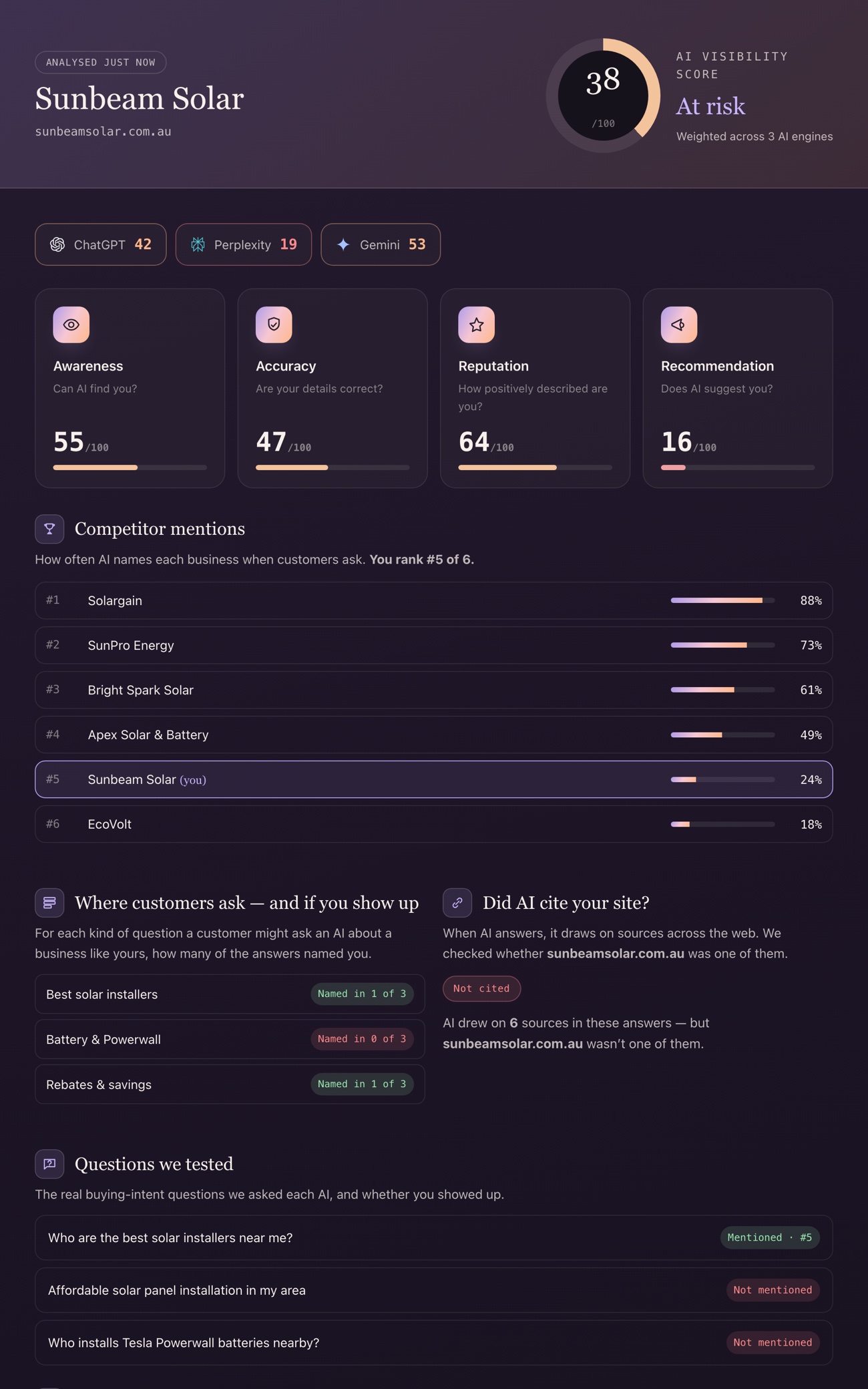
- Check what AI says about you today. Open ChatGPT, Gemini and Perplexity and ask for a business like yours in your town. Are you named? Are your facts right? Or are you skipped?
- Make your facts clean and consistent. Your name, phone, hours and services should match everywhere AI reads them – your site, Google, Facebook and directories. Conflicting facts make AI unsure, and unsure means skipped.
- Write like you're answering real questions. Plain answers to the things customers actually ask are easy for AI to quote. Marketing fluff isn't.
None of that requires betting on Google's death. It just makes you the business AI can read, understand and confidently recommend – which pays off whether the search world tips 10% toward AI or 60%. You're covered either way. That's the whole point of moving early: it's insurance, not a gamble.
If you'd rather not do the digging yourself, that's exactly what our free AI Visibility Audit is for. We ask the major AI engines about your business, then hand you a plain-English score and a fix list – so you can see where you stand before the shift decides for you.