 By Danielle Evaland
Why reputation now decides who AI recommends
Here's the shift that most business owners haven't caught up with yet. For twenty years, "search" meant a page of ten blue links, and you got to choose from them. Now, more and more, someone asks ChatGPT or Gemini "who's the best plumber near me?" and the answer isn't a list of ten – it's two or three names the AI already picked. If you're not one of them, you're not on page two. You're just not in the conversation at all.
And this isn't a niche behaviour any more. In BrightLocal's 2026 Local Consumer Review Survey, 45% of consumers said they'd used an AI tool like ChatGPT to find a local business in the past year – up from just 6% the year before. Over the same period, Google's share of that job slipped from 83% to 71%. AI is now the third most popular way people find local businesses, full stop.
So the real question becomes: when someone asks an AI, how does it decide which two or three names to give? A big part of the answer is your reputation. An AI doesn't want to recommend a business that might let the person down, so it leans hard on the signals that suggest you're actually good – and the loudest of those is your reviews. According to SOCi's 2026 Local Visibility Index, AI engines treat reviews as a kind of pass/fail confidence threshold rather than a sliding scale: the businesses ChatGPT recommends tend to sit around 4.3 stars, and a business with weak or barely-answered reviews is often excluded entirely, not just ranked lower.
That's the uncomfortable bit. The same report found ChatGPT recommends only about 1.2% of local business locations, versus 35.9% that show up in Google's old local three-pack. The bar is much higher, and reputation is one of the biggest things standing between you and the short list.
Reputation management = keeping a steady flow of recent, genuine, well-answered reviews across the platforms your customers (and the AI) actually look at – so you clear the trust bar and get named instead of skipped.
What a reputation management bot actually is

Most businesses handle reviews the same way: not really at all. A great job gets done, everyone's happy, and nobody ever asks for the review. Then, weeks later, one annoyed customer leaves a one-star and it sits there for a month with no reply because nobody was watching. That's the normal state of things, and it's quietly costing you.
A reputation management bot fixes the two failures that cause it – not asking, and not answering – by automating both. It's not a person and it's not a mystery. It's a small always-on system, usually wired into your CRM, that does three jobs on autopilot:
- It asks. When a job is finished or an invoice is paid, it sends the customer a friendly text or email with a one-tap link to leave a review – at the exact moment they're happiest.
- It watches. It monitors Google and the other places your reviews live, so a new review never sits unnoticed – you find out in minutes, not next month.
- It replies. It drafts a quick, personal response to every review – thanking the happy ones and calmly addressing the unhappy ones – so nothing is ever left hanging.
Notice what it is not: it's not a review-buying scheme, and it doesn't invent anything. Every review it produces comes from a real customer who really used you. All the bot does is remove the friction – the "I'll ask them later" and the "I'll reply to that when I get a minute" – that stops almost everyone from building a proper review habit.
A reputation bot doesn't create fake proof. It makes it effortless to collect real reviews and answer every one fast – turning something you keep meaning to do into something that just happens.
How a reputation bot works, step by step
From the outside it feels seamless, but the moving parts are simple. Here's what actually happens once it's set up for a business.
Speed is doing a lot of the work here. In BrightLocal's 2026 survey, 19% of consumers now expect a reply to their review on the same day they post it (up from 6% a year earlier), and 81% expect to hear back within a week. A human juggling a real business almost never hits that. A bot that's watching every platform can draft the reply the minute the review appears, so you're answering in hours, not "eventually".
The simplest way to picture it: it's the diligent front-desk person you wish you had – the one who asks every happy customer for a review, and answers every single one the same day – except it never forgets and never gets busy.
What AI looks at – and how the bot moves each lever
When an AI sizes up your reputation, it isn't just glancing at your star rating. It's reading the shape of your reviews: how many, how recent, how you engage, and whether the story holds up across more than one platform. Here are the three levers that matter most, what most businesses do with them, and what the bot does instead.
| What most businesses do | What a reputation bot does | |
|---|---|---|
| Volume & recency | Get the odd review by luck; the newest is six months old | Asks after every job, so fresh reviews arrive steadily all year |
| Responding to reviews | Reply to a few, ignore most, especially the bad ones | Drafts a fast, personal reply to every review, good and bad |
| Presence across platforms | A handful on Google and nothing anywhere else | Points customers to the platforms that matter, so the story lines up everywhere |
Why those three? Because the humans the AI is trying to serve care about them, and the research is blunt about it. 97% of consumers read reviews for local businesses, and 85% say positive reviews make them more likely to use a business while 77% say negative ones put them off. Recency is now a real filter, not a nicety: 74% of people specifically want to see reviews written in the last three months, and the share hunting for reviews from the last two weeks has jumped to 32%. A wall of glowing five-stars from two years ago reads as "used to be good" – to a customer and to an AI.
The reputation numbers that matter
That last one is the case for breadth. The average consumer looks across six different review sites before deciding – and AI engines do something similar, cross-checking your reputation against several sources to make sure the story is consistent. If you're strong on Google but invisible everywhere else, both the human and the AI notice the gap. The bot's job is to keep all three levers moving at once, quietly, so your reputation reads as alive and trustworthy from every angle.
Doesn't automating reviews feel fake?

This is the fair question, and I want to be straight about it, because there's a right way and a wrong way to do this.
The wrong way is to fake it – buy reviews, write your own, or blast the same copy-paste "Thanks for your feedback!" under every single one. Don't. Fake reviews break Google's rules and, in a lot of places, the law. And the lazy templated reply backfires with real people: BrightLocal found that generic or templated replies actively put off 50% of consumers. A reply that could have been sent to anyone reads as "we don't really care", which is worse than saying nothing.
The right way – and the only way we set it up – is to use automation for the timing and the reminding, and keep the substance genuine. The reviews are real, from real customers. The replies are drafted to reference what that specific person actually said, and you get to glance at them before they go out. You stay the human; the bot just makes sure the human thing actually happens, every time, fast.
One honest caveat: a reputation bot amplifies whatever is really there. If the work is good, it turns quiet happy customers into a steady stream of proof. If the work is genuinely bad, no automation will paper over it – and it shouldn't. Fix the service first; then let the bot tell the world.
Automation should carry the admin, never the honesty. Real reviews, real replies – the bot just makes sure they never get forgotten.
Danielle Evaland, Founder of EvaraIs a reputation bot right for you?
It isn't for everyone, and I'd rather tell you that than oversell it. A reputation management bot earns its keep when a few things are true:
- You serve real customers who could review you. Local and service businesses – trades, clinics, dealerships, home services – live and die by reviews, so this is squarely for you.
- You already do good work. The bot amplifies your real reputation. If your customers are happy, it turns that into visible, ongoing proof.
- Reviews aren't happening on their own. If your newest review is months old and half sit unanswered, that's exactly the gap this closes.
- You want AI to name you, not your competitor. A fresh, well-answered review profile is one of the clearest signals that pushes an engine to pick you.
Here's the bigger picture, though. Reputation is one piece of getting recommended by AI, not the whole thing. An engine also has to be able to read your website and resolve who and where you are before your reviews ever get a look-in. A reputation bot works best as part of getting your whole business AI-ready.
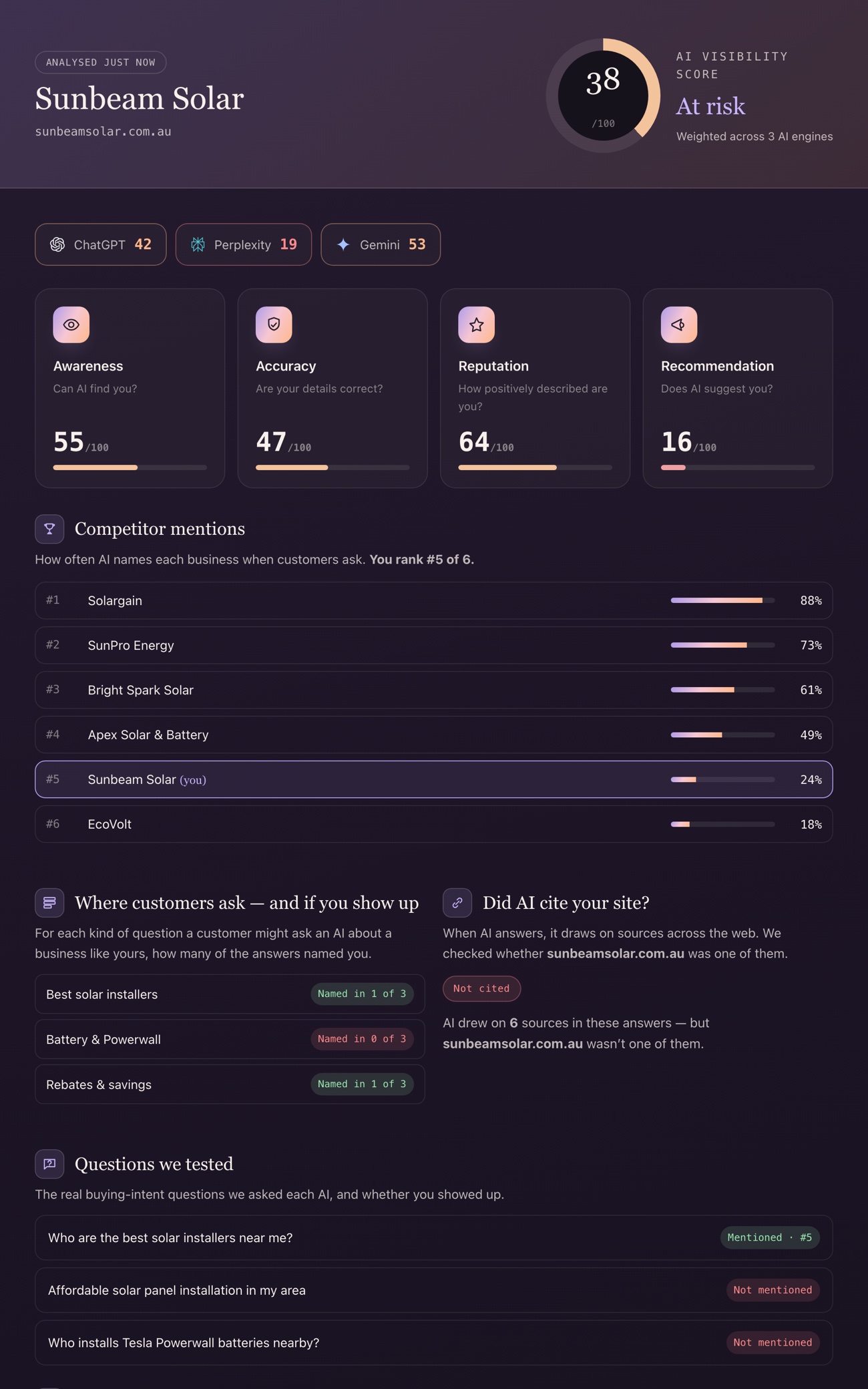
If you're not sure where your reputation stands with the engines today, that's the honest place to start. Our free AI Visibility Audit asks ChatGPT, Gemini and Perplexity about your business and scores you across four pillars – one of which is reputation – so you can see exactly whether your reviews are helping you get named or quietly getting you skipped. And if you want the wider view of how all this fits together, start with what AI visibility is and why it matters.